
Ever since I made my first pull through screen soap, I have tried my hand at making different screens and testing the results, like the honeycomb one, the heart shaped, and snowflake among others, with mixed results. I know, in theory, what works best for this technique: a recipe that stays fluid (at trace) for a while, a rounded column mold, and pouring alternating contrasting colors with condiment bottles, or anything else that allows an even, centered pour. This technique comes after all from the painting world.
In practice, though, because of my recipe, fragrance acceleration or lack of patience, my pour is done at thick trace, in a “fall as you will” sort of way, with mixed results. However, I have noticed that the most definition of the screen occurs within the first couple of soaps from the bottom.
For slab molds or loaf molds, a screen with a pattern design with uniform geometric shapes is what is generally used and what works best (like the honeycomb from above) However, after testing a screen I had made several years ago recently, I started wondering if I could “pull off” a kaleidoscope style soap in a loaf mold. So I drew one, with different flowers to test which one worked best, 3d printed it and tried it this past week. Instead of using contrasting colors as usual, I decided to use bright neon colors.
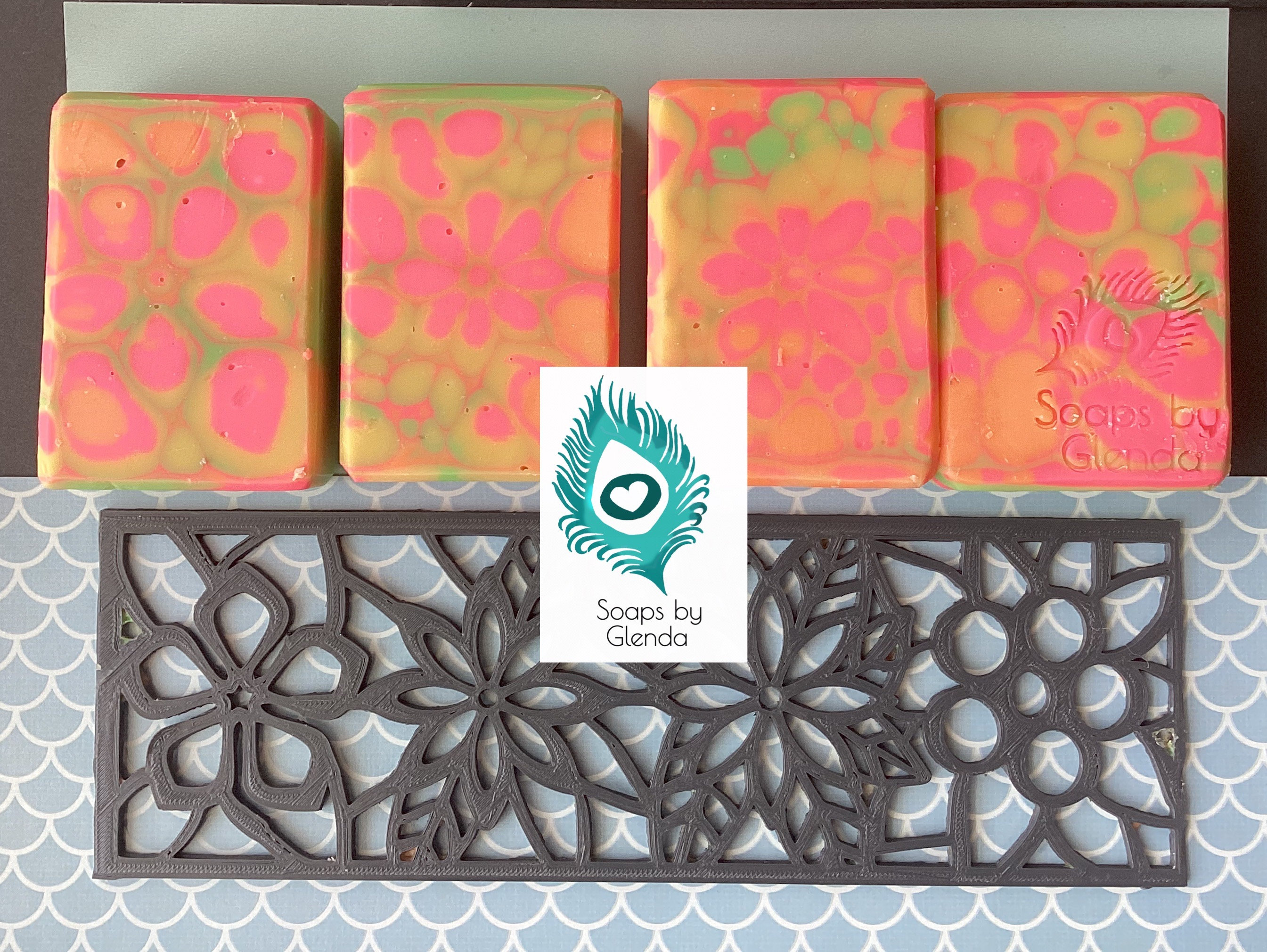
I am quite pleased with the results and have already redesigned new screens to improve on the design. I use loaf molds more often than column vertical molds (a PVC pipe that I need to seal and grease before hand), so this opens up a new playing field for me.
You can watch the video of the pour below, and you can purchase the screen from my shop here.
Soap Ingredients
Your can also view it in lyecalc.com here
Needed Ingredients
Note: This recipe sets out fast, you could increase the water to 33% instead of 40, and increase the olive oil in a lye calculator. Or work at room temperature with the oils (or at 90 F)
| Ingredient | Gram(s) | Ounce(s) | Pounds(s) | Oil % |
|---|---|---|---|---|
| Coconut Oil, 76 deg | 208.65 | 7.36 | 0.46 | 23% |
| Ricinus Oil (Castor Oil) | 54.43 | 1.92 | 0.12 | 6% |
| Karite Butter (Shea) | 99.79 | 3.52 | 0.22 | 11% |
| Olive Oil – All Grades | 281.23 | 9.92 | 0.62 | 31% |
| Tallow, Beef | 263.08 | 9.28 | 0.58 | 29% |
| Ingredient | Gram(s) | Ounce(s) | Pounds(s) | Batch % |
| NaOH (5% Superfat) | 119.28 | 4.21 | 0.26 | 9.64% |
| KOH (5% Superfat) | 8.83 | 0.31 | 0.02 | 0.71% |
| Water (40% Lye + 60% Water Solution) | 192.16 | 6.78 | 0.42 | 15.53% |
| Total Oils | 907.18 | 32 | 2 | 73.30% |
| Soap Weight (Pre-Cook) | 1,237.57 | 43.65 | 2.73 | 100% |
Custom Additives
| Add with the Fats | ||
|---|---|---|
| Rosemary oleoresin (you will need jewelers scale or small precision scale) | 0.02 oz | 0.46 g |
| Add at trace | ||
| EDTA solution (mixed 50/50 with distilled water) | 0.44 oz | 13 g |
For more information on these additives you can click in the links below, please note above links are affiliate ones
- Rosemary oleresin (My oils already had this added when I masterbatched the oils)
- Tetrasodium EDTA
Colorants:
- Green: 1/4 tsp of Kiwi Green Mica from WSP + 1/4 tsp of Fluorescent Neon Green from Nurture Soap for 1/4 of the soap or about 11 oz
- 1/2 tsp of Neon pink from Makeyourown for 1/4 of the soap of 11 oz
- 1/2 Banana yellow mica from WSP + 1/8 neon yellow pigment for 1/4 of the soap batter
- 1/2 tsp of Orange Vibrance Mica (Nurture soap aff link) + 1/8 Orange Neon pigment for 1/4 of the soap batter
Mold:
Fragrance:
2 oz of Mango Sorbet from Nature’s Garden
Equipment
Safety Equipment:
- Nitrile gloves
- Facial Shield (I use either a facial shield or the goggles below)
- Safety Goggles
- Respirator (I use this when mixing the lye, I mix the lye in the window sill, window opened, with a pedestal fan blowing the fumes away, better yet, freeze your distilled water prior) I also try to wear long sleeves, pants and closed shoes. In my personal experience, most of my near misses (when I feel my skin itching or a slight burning sensation), or when I come contact with the soap batter, have happened when I am wiping down the containers, when I am almost done.
Process
- First, prepare the screen by figuring out how you will pull it out, I have used wires as a cord, but what worked best were trimmed steel rods that can fit a hex nut in the end.
- It is a good idea to mixed the micas with olive oil or any clear oil, and measure the fragrances. I use Long and skinny spatulas to do this.
- To make the soap, I normally heat up some of my masterbatched oils, weigh what I need and set it apart.
- Then I measure the masterbatched lye needed. However, if you do not masterbatch the oils or lye, I detail it below:
- In a well ventilated area (outside or by a window), add the lye gradually to the distilled water. Do not breathe the fumes. You can freeze half of the water ahead to avoid fumes, and weigh the ice cubes. You need to wear your safety gear. Lye burns! You can prepare this several hours ahead, or even days ahead, keep it properly covered. (If making it the same day, loosely cover it to allow it to cool down. Once at room temperature, use an airtight lid).
- While you wait for the lye water to cool down, you can weigh and melt your oils. Weigh your fragrance oil or essential oils into a glass container or ceramic container (fragrance oils can dissolve thin plastics).
- When your oils and lye solution are at or below 105°F (37.77°C), put on your PPE (Personal protective equipment) again, and add your lye solution to the oils slowly, to avoid splatters pour it on the blender shaft. If your lye solution is cooler than this, is ok. As long as it not near freezing. (Room temperature is fine). If your oils go under 95° F, warm them up to lightly above 100° F
- Stir with the blender on Off position initially, then blend for 5-7 second periods, alternating with stirring for 10 seconds or longer, until it is emulsified. This takes about 30-50 seconds with this recipe. When a recipe reaches emulsion, everything has a uniform, lighter color than before, you do not see the darker oil swirls when blending.
- Distribute among the funnel pitchers and blend the color for each
- Add 1/4 of the fragrance to each container soap and stir for about 30 seconds. If the fragrance does not accelerate, blend some more to bring soap batter to light trace, or you can wait until it reaches trace on its own (it can take 10-15 minutes, this is good if you have the patience needed, as it will stay fluid for longer)
- Put the screen at the bottom of the soap mold if not already in place
- Pour each color in alternating layers. You can do a wall pour to achieve this, or use a spatula to break the fall of new layers. I used the long spout and ended with accidental pointy layers on the edges.
- When done pouring, pull the screen out, try to keep it even, scrape any leftovers on top and even it out if needed.
- Cover with plastic to avoid soda ash if using a different recipe from above. With aboe recipe I usually do not get soda ash. Otherwise, (I use Press and seal) and I try to promote gel phase by putting a heating pad on the floor, putting a box on top, and covering it with a blanket. I leave the heating pad on for 5 hours or so, on High.
- Wait 18-24 hours hours to remove, then divide the loaf mold in 4 sections 2.5″ wide each. From each portion you will get 2 soaps, but you need to cut them horizontally (not like bread slices, but like if you were making large cake layers)
- Let the soap cure for at least 4 weeks in an open area protected from direct sunlight before using. (not touching any metal)
Some concepts explained:
*SUPERFAT:
By now you probably know that lye (sodium hydroxide) converts oils into soap, through a process called saponification. And you probably also know that there are specific amounts needed of each for this to happen. Because each soap has a different SAPonification value, different amounts of lye are needed for each oil.
Superfatting sounds like something I like to do to myself when I keep eating after I feel full. But in the soap world, many will know it is when you either add more oils or less lye than it is required. Let’s say, hypothetically, that you need 3 oz of lye to convert 16 oz of manacao oil (totally made up oil) into soap. If you only use 2.5 oz of lye instead of 3, that means that a percentage of the manaco oil will not become soap, but will remain an oil. And this is desirable as that extra oil will cause the soap to become more gentle on your skin, by reducing its cleansing ability slightly. But if you use 4 oz of lye instead of 3, that means all 16 oz of manacao oil will become soap, and not only that, there will be extra lye floating around. That extra lye will be looking for more oil to convert to soap, that oil could be the natural skin oils, which means this soap can burn or irritate the skin.
Usually superfat of at least 3% is recommended as oils properties may change from crop to crop. But even if you had a 0% superfat soap, it would still be gentle as handmade soap creates glycerin, which is a skin humectant. (From most commercially produced soap, glycerin is removed to be sold separately).
*LYE CONCENTRATION / WATER DISCOUNT:
Most soap calculators will give you the amount of water needed to mix the lye with, based on traditional cooking methods of making soap, what we now know as hot process. This is a big percentage of water (38% of the oils) because a lot of it would evaporate through the cooking process. However, for cold process soap this is usually too much water, which can lead to a lot of soda ash or a lot of shrinkage during the cure.
This blogpost explains it better (from modern soapmaking).

 Soaps by Glenda
1 thought on “Floral Kaleidoscope Soap in loaf mold”