
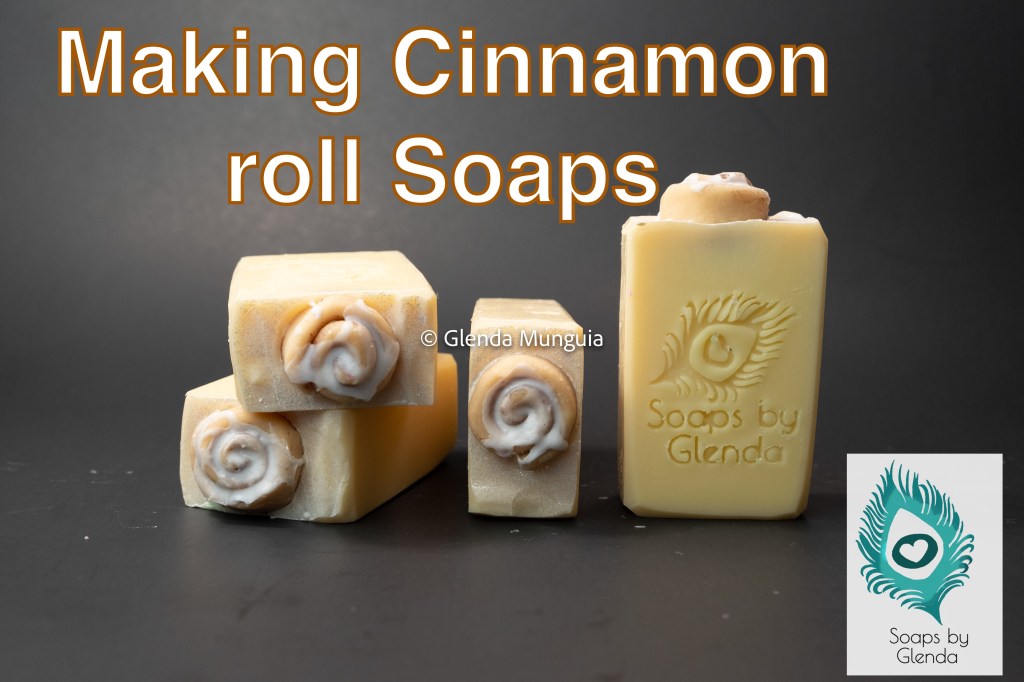
About once a year I get a craving for a cinnamon roll from Cinnabon. (I do not dare making them myself as I believe me capable of eating an entire batch, like I have proven I can do with Brazilian cheese bread.) Earlier this year, I got a different kind of craving, I wanted to make a cinnamon roll soap, one that actually look like one, in real size. But after looking for possible molds for them, I realized it would be easier to make just miniature versions of them with soap dough, so here we are.
Here is how I made them and below the supplies used.
Here is the video of the making:
https://youtu.be/O5U6Gf7UYUM
Recipe Totals
| Liquid Required | 2.63 oz | 74.6 g |
| NaOH Weight at 99 % Purity | 1.68 oz | 47.59 g |
| KOH Weight at 90 % Purity | 0.08 oz | 2.14 g |
| Lye Weight | 1.75 oz | 49.73 g |
| Oil Weight | 12 oz | 340.19 g |
| Fragrance Weight | 0.75 oz | 21.26 g |
| Super Fat | 3 % | |
| Total Batch Weight | 17.14 oz | 485.95 g |
| NaOH / KOH Ratio | 97.2 % / 2.8 % | |
| Lye Concentration | 40 % | |
| Liquid : Lye Ratio | 1.5:1 |
Please note that the recipe above has a a very low superfat* percentage, dual lye and a considerable discount-lye water concentration*. If you are a beginner, a recipe like this one might be better.
Custom Additives
| Add with the Fats | ||
|---|---|---|
| Rosemary oleoresin | 0.01 oz | 0.23 g |
| Add at trace | ||
| EDTA mixed with water | 0.23 oz | 6.45 g |
Colorant:
1/2 tsp Winter White Mica
Molds:
Fragrance:
0.70 oz Cinnamon Supreme
0.30 oz Pumpkin and Brown Sugar
0.50 oz of vanilla stabilizer
Embeds
To make the embeds I used soap dough. I used gold mica to get the main color. You can check the video for the process. Or use a mold like this one.
Additionally, I used white melt and pour for the glaze and brown oxide powder for the cinnamon effect.
Equipment
Safety Equipment:
- Nitrile gloves
- Facial Shield (I use either a facial shield or the goggles below)
- Safety Goggles
- Respirator (I use this when mixing the lye, I mix the lye in the window sill, window opened, with a pedestal fan blowing the fumes away, better yet, freeze your distilled water prior) I also try to wear long sleeves, pants and closed shoes. In my personal experience, most of my near misses (when I feel my skin itching or a slight burning sensation), or when I come contact with the soap batter, have happened when I am wiping down the containers, when I am almost done.
Some concepts explained:
*SUPERFAT:
By now you probably know that lye (sodium hydroxide) converts oils into soap, through a process called saponification. And you probably also know that there are specific amounts needed of each for this to happen. Because each soap has a different SAPonification value, different amounts of lye are needed for each oil.
Superfatting sounds like something I like to do to myself when I keep eating after I feel full. But in the soap world, many will know it is when you either add more oils or less lye than it is required. Let’s say, hypothetically, that you need 3 oz of lye to convert 16 oz of manacao oil (totally made up oil) into soap. If you only use 2.5 oz of lye instead of 3, that means that a percentage of the manaco oil will not become soap, but will remain an oil. And this is desirable as that extra oil will cause the soap to become more gentle on your skin, by reducing its cleansing ability slightly. But if you use 4 oz of lye instead of 3, that means all 16 oz of manacao oil will become soap, and not only that, there will be extra lye floating around. That extra lye will be looking for more oil to convert to soap, that oil could be the natural skin oils, which means this soap can burn or irritate the skin.
Usually superfat of at least 3% is recommended as oils properties may change from crop to crop. But even if you had a 0% superfat soap, it would still be gentle as handmade soap creates glycerin, which is a skin humectant. (From most commercially produced soap, glycerin is removed to be sold separately).
*LYE CONCENTRATION / WATER DISCOUNT:
Most soap calculators will give you the amount of water needed to mix the lye with, based on traditional cooking methods of making soap, what we now know as hot process. This is a big percentage of water (38% of the oils) because a lot of it would evaporate through the cooking process. However, for cold process soap this is usually too much water, which can lead to a lot of soda ash or a lot of shrinkage during the cure.
This blogpost explains it better (from modern soapmaking).

 Soaps by Glenda