
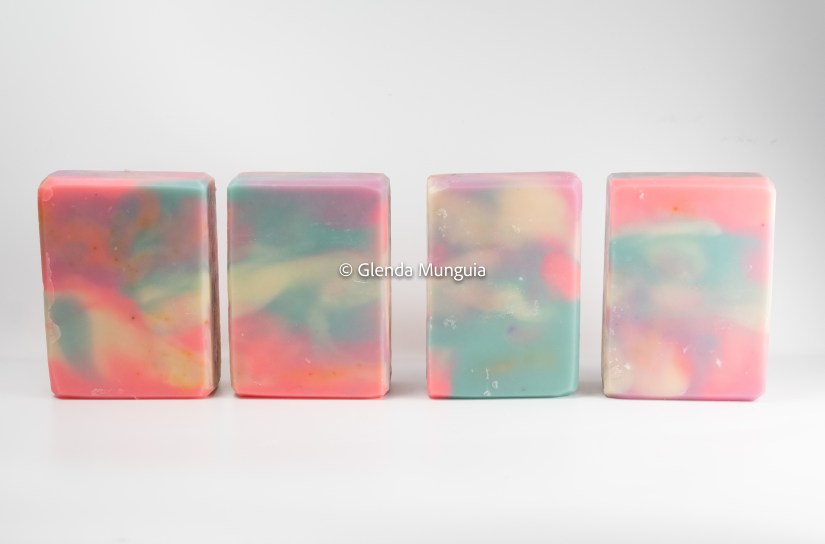
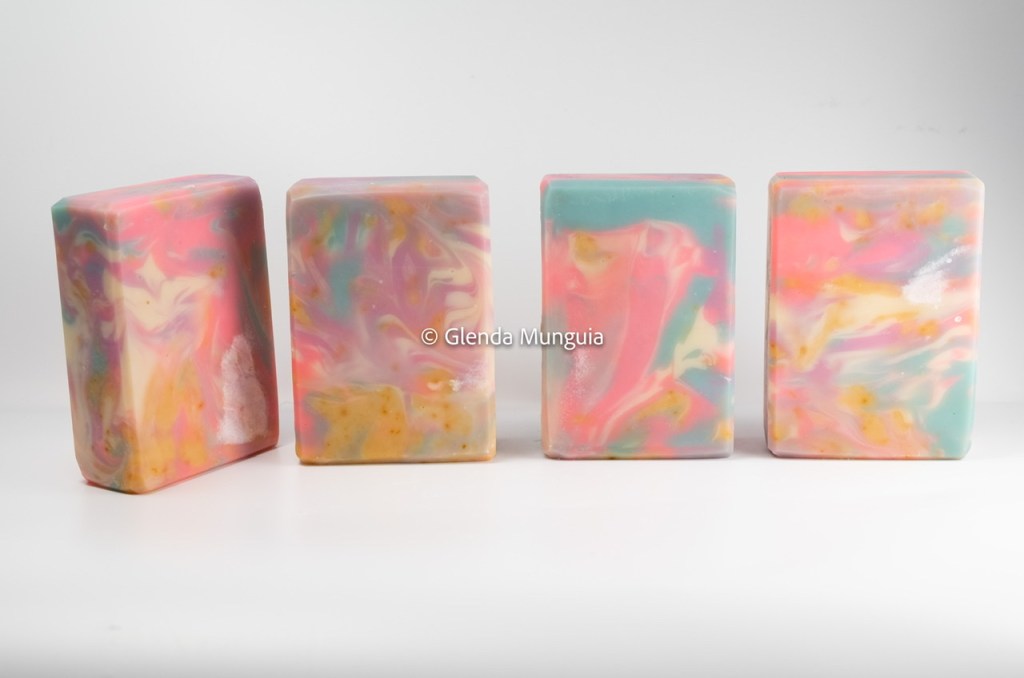
The inspiration for this soap came when I was watching a murder mystery TV show (“Only murders in the building”) starring Steve Martin, Martin Short and Selena Gomez. Though I generally like murder mysteries, I try not to watch them in the evening because it affects my dreams a bit too much, but this particular show is also a comedy, so that helped keep it lighthearted. The actual inspiration was a tie dye hoody that one of the initial suspects was wearing. I wanted to recreate the pattern and colors in a soap and here we are.
Colorants:
This is my best guess of how much I used for 4 oz of soap, I cannot find the footage that shows me measuring, sometimes technology works against us, when we rely too much on it.
1/8 tsp Pink Neon mica from Make your own
1/8 tsp Fluorescent Neon Purple from Nurture Soap
1/8 tsp Fluorescent Neon Blue
1/2 tsp tomato puree
1/8 tsp Winter White Mica
Mold:
10″ Silicone loaf mold from Nurture Soap
Fragrance:
1 oz of Awaken from Nurture Soap, a very fresh, lemony scent that has lasted so far for about a month in the soap. It behaved very well in the soap as well.
Equipment
Safety Equipment:
- Nitrile gloves
- Facial Shield (I use either a facial shield or the goggles below)
- Safety Goggles
- Respirator (I use this when mixing the lye, I mix the lye in the window sill, window opened, with a pedestal fan blowing the fumes away, better yet, freeze your distilled water prior) I also try to wear long sleeves, pants and closed shoes. In my personal experience, most of my near misses (when I feel my skin itching or a slight burning sensation), or when I come contact with the soap batter, have happened when I am wiping down the containers, when I am almost done.
Recipe Totals
Please note that this recipe has a a very low superfat* percentage, dual lye and a considerable discount-lye water concentration*. If you are a beginner, a recipe like this one might be better.
Recipe Oils, Fats and Waxes
| Oil | % | Ounces | Grams |
|---|---|---|---|
| Castor Oil | 8 | 1.28 | 36.29 |
| Coconut Oil, 76 deg | 25 | 4 | 113.4 |
| Olive Oil | 30 | 4.8 | 136.08 |
| Shea Butter | 7 | 1.12 | 31.75 |
| Tallow Beef | 30 | 4.8 | 136.08 |
| Total | 100 | 16 | 453.59 |
Custom Additives
| Add with the Fats | ||
|---|---|---|
| Rosemary oleoresin | 0.01 oz | 0.23 g |
| Add at trace | ||
| EDTA mixed with water | 0.23 oz | 6.45 g |
Fragrances
| Awaken | 0 g | |
| Total | 1 oz | 0 g |
Recipe Totals
| Liquid Required | 4.44 oz | 97.41 g |
| NaOH Weight at 99 % Purity | 2.19 oz | 62.15 g |
| KOH Weight at 90 % Purity | 0.1 oz | 2.79 g |
| Lye Weight | 2.29 oz | 64.94 g |
| Oil Weight | 16 oz | 453.59 g |
| Fragrance Weight | 1 oz | 28.35 g |
| Super Fat | 5 % | |
| Total Batch Weight | 22.73 oz | 644.52 g |
| NaOH / KOH Ratio | 97.2 % / 2.8 % | |
| Lye Concentration | 34 % | |
| Liquid : Lye Ratio | 1.5:1 | |
| Saturated : Unsaturated | 45:55 |
TO MAKE SOAP:
*SUPERFAT:
By now you probably know that lye (sodium hydroxide) converts oils into soap, through a process called saponification. And you probably also know that there are specific amounts needed of each for this to happen. Because each soap has a different SAPonification value, different amounts of lye are needed for each oil.
Superfatting sounds like something I like to do to myself when I keep eating after I feel full. But in the soap world, many will know it is when you either add more oils or less lye than it is required. Let’s say, hypothetically, that you need 3 oz of lye to convert 16 oz of manacao oil (totally made up oil) into soap. If you only use 2.5 oz of lye instead of 3, that means that a percentage of the manaco oil will not become soap, but will remain an oil. And this is desirable as that extra oil will cause the soap to become more gentle on your skin, by reducing its cleansing ability slightly. But if you use 4 oz of lye instead of 3, that means all 16 oz of manacao oil will become soap, and not only that, there will be extra lye floating around. That extra lye will be looking for more oil to convert to soap, that oil could be the natural skin oils, which means this soap can burn or irritate the skin.
Usually superfat of at least 3% is recommended as oils properties may change from crop to crop. But even if you had a 0% superfat soap, it would still be gentle as handmade soap creates glycerin, which is a skin humectant. (From most commercially produced soap, glycerin is removed to be sold separately).
*LYE CONCENTRATION / WATER DISCOUNT:
Most soap calculators will give you the amount of water needed to mix the lye with, based on traditional cooking methods of making soap, what we now know as hot process. This is a big percentage of water (38% of the oils) because a lot of it would evaporate through the cooking process. However, for cold process soap this is usually too much water, which can lead to a lot of soda ash or a lot of shrinkage during the cure.
This blogpost explains it better (from modern soapmaking).

 Soaps by Glenda