

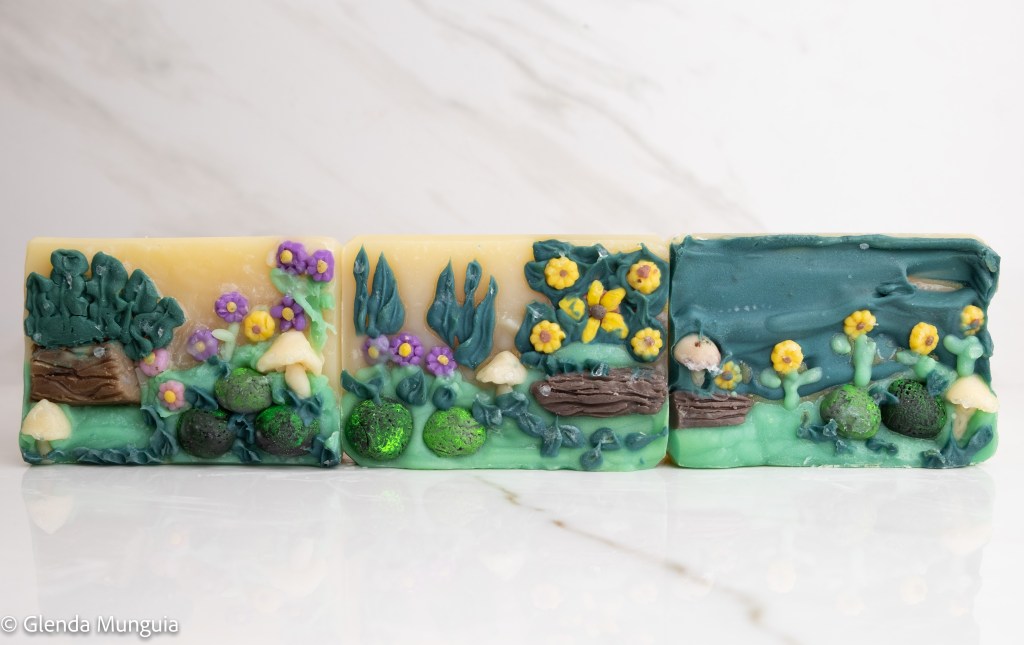
The soapmaking forum June challenge of last year was an inspiration challenge, meaning that as long as you were inspired by the challenge theme, any technique could be used in the soap. I signed up for the challenge with nothing concrete in mind. The theme was Garden Inspiration, and not necessarily one’s own garden. It could be a tree, a fruit, etc.
I had been thinking of doing something like a moss garden soap for a while, with mushrooms, a log, flowers. However, part of the challenge was to use an ingredient other than the fragrance, that is inspired by a garden. I learned recently that it is not safe to add moss to soap*, and I was not sure if I wanted to add mushroom soap embeds to a soap again and again. On the one hand, I like to do easy techniques, on the other hand, I get bored of doing the same techniques over and over, and therein lies the conundrum.
In the end I went with the original idea and I was happy with the result. For the garden ingredient, I chose grass, which I boiled, and used the remaining water in the lye solution. My expectation was that the chlorophyll in the grass would color the soap green, but much like the cilantro soap, it only gave it a faint yellow.
Below is the recipe, supplies and process I used. Some of the links are affiliate links which means that if you buy anything from them, I may receive a small % back.
*Depends on the moss, oakmoss and treemoss (which may actually be lichens) have sensitizing compounds and are not considered skin safe except in the tiniest of amounts, the culprit in oakmoss is atranol. You can find more information and links here in the forum discussion.
Recipe Oils, Fats and Waxes
If you are a beginner, a recipe like this one might be better. This would be more of an intermediate project, once you have several batches under your belt. Below I am using a water discount, and a dual lye blend.
| Oil | % | Ounces | Grams |
|---|---|---|---|
| Olive Oil | 30 | 4.8 | 136.08 |
| Tallow Beef | 30 | 4.8 | 136.08 |
| Coconut Oil, 76 deg | 25 | 4 | 113.4 |
| Castor Oil | 8 | 1.28 | 36.29 |
| Shea Butter | 7 | 1.12 | 31.75 |
| Total | 100 | 16 | 453.59 |
Recipe Totals
| Liquid Required | 3.48 oz | 98.59 g |
| NaOH Weight | 2.14 oz | 60.74 g |
| KOH Weight | 0.18 oz | 4.98 g at 90% Purity |
| Lye Weight | 2.32 oz | 65.73 g |
| Oil Weight | 16 oz | 453.59 g |
| Fragrance Oil Weight | 1 oz | 28.35 g |
| Superfat | 5% | |
| Total Batch Weight | 23.02 oz | 652.72 g |
| Lye Concentration | 40% | |
| NaOH / KOH Ratio | 95% / 5% |
Note: I used extra water that came from the boiling the grass in it, so the total lye concentration was 34%
Custom Additives (Optional)
| Add with the Fats | |
|---|---|
| Rosemary oleoresin | 0.01 ounce |
| Add at trace | |
| EDTA mixed with distilled water (50/50) | 0.23 ounce |
For more information on these additives you can click in the links below, please note above links are affiliate ones
- Rosemary oleresin (My oils already had this added when I masterbatched the oils)
- Tetrasodium EDTA
My affiliate links:
Several of the links above/below are affiliate links, as the ones below. If you would like to support this blog, you can use them to buy any item from those stores, it will not cost you any more, and I would get a tiny % commission on it. As amazon associate I earn from qualifying purchases.
NURTURE SOAP
AMAZON
MAKE YOUR OWN
Colorants:
- Laurel Green mica, 1/4 tsp for a small amount of soap batter
- Savage Green Mica from Nurture Soap 1/4 tsp plus Fluorescent Neon Green from Nurture Soap for a small amount of soap batter
Mold:
Rectangle 4 cavity mold from Crafter’s Choice
Fragrance:
- Satsuma from Wholesale Supplies
- Rose Fragrance formulator from Wholesale Supplies Plus
- Patchouli from Lone Star Candle supplies
I added DIY vanilla stabilizer (0.50 oz)
Embeds
I made them with Soap dough and hand shaped most of them, except I used a tiny flower mold I made, similar to this.
Here are other molds that could help:
Piping
I used the leaf tip from below set:
Reusable piping bag set with tips
Equipment
Safety Equipment:
- Nitrile gloves
- Facial Shield (I use either a facial shield or the goggles below)
- Safety Goggles
- Respirator (I use this when mixing the lye, I mix the lye in the window sill, window opened, with a pedestal fan blowing the fumes away, better yet, freeze your distilled water prior) I also try to wear long sleeves, pants and closed shoes. In my personal experience, most of my near misses (when I feel my skin itching or a slight burning sensation), or when I come contact with the soap batter, have happened when I am wiping down the containers, when I am almost done.
MAKING THE SOAP
- First it is a good idea to mixed the micas with olive oil or any clear oil, and measure the fragrances. I use Long and skinny spatulas to do this.
- I also boiled the grass clippings ahead, this smelled bad to me, I would not recommend. After boiling it, I saved the water and used it as part of lye water solution, straining out any grass pieces.
- To make the soap, I normally heat up some of my masterbatched oils, weigh what I need and set it apart.
- Then I measure the masterbatched lye needed. To this, I added about 1.5 oz of the water in which I boiled the grass. However, if you do not masterbatch the oils or lye, I detail it below:
- In a well ventilated area (outside or by a window), add the lye gradually to the distilled water. Do not breathe the fumes. You can freeze half of the water ahead to avoid fumes, and weigh the ice cubes. You need to wear your safety gear. Lye burns! You can prepare this several hours ahead, or even days ahead, keep it properly covered. (If making it the same day, loosely cover it to allow it to cool down. Once at room temperature, use an airtight lid).
- While you wait for the lye water to cool down, you can weigh and melt your oils. Weigh your fragrance oil or essential oils into a glass container or ceramic container (fragrance oils can dissolve thin plastics).
- When your oils and lye solution are at or below 105°F (37.77°C), put on your PPE (Personal protective equipment) again, and add your lye solution to the oils slowly, to avoid splatters pour it on the blender shaft. If your lye solution is cooler than this, is ok. As long as it not near freezing. (Room temperature is fine). If your oils go under 95° F, warm them up to lightly above 100° F
- Stir with the blender on Off position initially, then blend for 5-7 second periods, alternating with stirring for 10 seconds or longer, until it is emulsified. This takes about 30-50 seconds with this recipe. When a recipe reaches emulsion, everything has a uniform, lighter color than before, you do not see the darker oil swirls when blending.
- Add the fragrance to the soap and stir for about 30 seconds.
- Pour into mold cavities, save some for the piping.
- Color leftovers with the green micas, I did a dark and a light green.
- Add some of the green colored soap on top, as a background for the garden, then add embeds carefully
- Once piping soap is thick enough, pipe leaves with the leaf tip
- Cover with plastic to avoid soda ash (I use Press and seal) I try to promote gel phase by putting a heating pad on the floor, putting a box on top, and covering it with a blanket. I leave the heating pad on for 5 hours or so, on High.
- Wait 48 -72 hours hours to remove, the longer the better to avoid soda ash.
- Let the soap cure for at least 4 weeks in an open area protected from direct sunlight before using. (not touching any metal)

 Soaps by Glenda