


I have been in the hunt for a coconut fragrance early since I made my first soap. I have found several that are good, but not good enough to make me want to get more of them. The main problem has been either acceleration or discoloration. The one I used for this soap is actually good, but it does discolor. Which is what led me to choose this design. Its fragrance reminds me of toasted coconut, the name is Coconut Shavings from Bulk Apothecary.
What is the film on lye water?
I mixed the lye with the water the day before, not in one of my usual containers with a good fitting lid, but a pitcher kind, which caused a film to form on the surface. I usually have some of this and I strain it, but this one was thicker than normal. Which prompted me later to look it up. I have watched different soap makers online who either strain it or do not strain it. I knew it had to do with the lye reacting with the oxygen. I figured if someone knew the facts about it, it would be Kevin Dunn, as I remembered watching this video before.
In this page they explain it better than I could:
“What is that film on my lye water? That film is perfectly normal. It is merely the Sodium Carbonate (Na2CO3) which is already in the Sodium Hydroxide (a maximum of 1.6%), as can be seen in the Certificate of Analysis at http://www.EssentialDepot.com/MSDS. Secondarily, the Sodium Carbonate is a by-product of chemical reactions between your lye water and the oxygen in the air. ” Essential depot
Now that we are talking about lye…
In the same page, I found this paragraph (the page explains why some soap batches fail):
“Exposure to air. Since Sodium Hydroxide is hygroscopic, it absorbs moisture. This includes the moisture in the air. For this reason you should not measure your Sodium Hydroxide until you are ready to mix it with your water/liquid. If the Sodium Hydroxide sits exposed to the air, then it absorbs the moisture from the air diluting the Sodium Hydroxide. So, it only makes sense, that if you live in a very humid area then your Sodium Hydroxide will be diluted more than if you live not so humid area.” Essential depot
I live in a very humid area, and my first soap batches took a long time to set. I had purchased my lye from an individual who had it for perhaps a couple of years or so. Some of the lye had formed into clumps, I did not know any better back then, so I thought soap took a long time to set up. Once I bought fresh lye, my soap making improved! The bars were ready to unmold faster and were not so soft.
In this video, you can see Kevin Dunn setting lye aside at the beginning of his speech, and weighing it then. Later when he is almost done, he weighs it again, and it is now heavier! They lye has absorbed moisture from the air so we can deduct that if your recipe calls for 2 oz of lye for example, and your lye has absorbed water from the environment, you may weigh 2 oz, but perhaps 0.20 oz from that (just as an example) will be moisture and not lye. So in reality, you are only putting 1.80 oz of lye (I made up the numbers, but you get the gist).
Now back to this soap, here is the recipe, video link all below:
Beach Soap
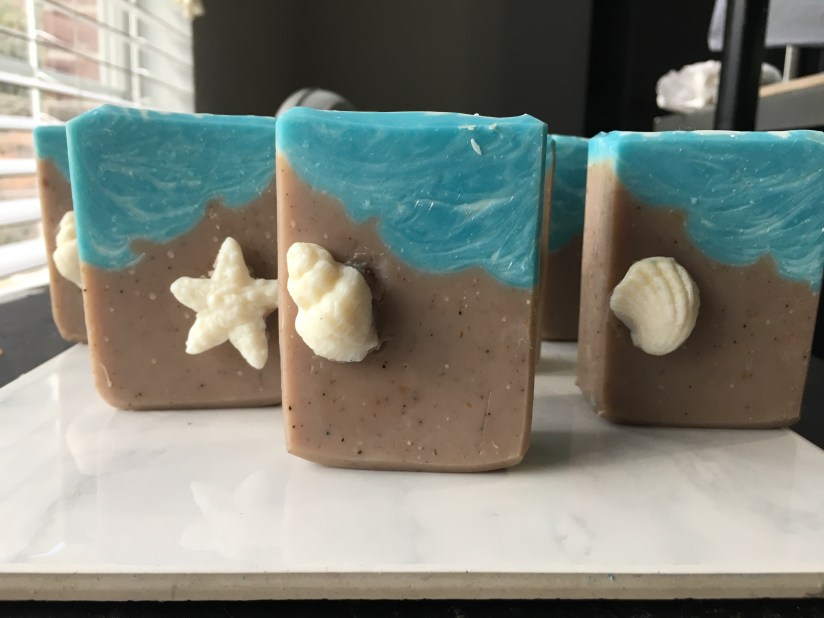
Mold:
Skinny tall mold, mine was 10 7/8″ long x 2, 3/8″ wide and 3, 3/8″ tall or: 27.75 cm long, 6 cm wide, 8.5 cm tall.
To adapt this recipe to other mold size, visit this lye calculator.
Lye and water amounts:
| Liquid Required | 8.32 oz | 235.86 g |
| NaOH Weight | 5.55 oz | 157.24 g |
Recipe Oils, Fats and Waxes
| Oil | % | Ounces | Grams |
|---|---|---|---|
| Tallow Beef | 26 | 10.4 | 294.83 |
| Coconut Oil, 76 deg | 22 | 8.8 | 249.48 |
| Olive Oil | 17 | 6.8 | 192.78 |
| Rice Bran Oil, refined | 15 | 6 | 170.1 |
| Shea Butter | 11 | 4.4 | 124.74 |
| Castor Oil | 9 | 3.6 | 102.06 |
| Total | 100 | 40 | 1133.98 |
| Superfat | 5% | |
| Total Batch Weight | 55.27 oz | 1566.77 g |
| Lye Concentration | 40% | |
| Liquid : Lye Ratio | 1.5 :1 | |
| Saturated : Unsaturated | 44:56 |
Additives / Exfoliants
- 2 teaspoons blend of coffee grounds, ground oatmeal and cornmeal (the blend had 2 tsp of ground oats, 1 tsp of corn meal and 1 tsp of coffee grounds, I used this blend for another soap too)
- 1/2 teaspoon of titanium dioxide dispersed in olive oil. (Approximately, as I had blended 2 tsp with oil, and I took 1 teaspoon of this blend and added to 5 oz of soap batter)
- 1/4 teaspoon Crafter’s Choice Turquoise Teal Mica dispersed in a light colored soap, such as olive oil or sunflower oil.
Embeds
Seashell embeds, I made mine with white soap dough, and a sea shell mold I made with caulking silicone. My embeds were cured (for over a month), which allowed me to press them hard on the finished soap without breaking. If yours are softer, be careful when adding them to the soap bars.
Alternatively, you can make them with melt and pour soap, and a mold similar to this one.
Fragrance:
1.40 oz of Coconut Shavings from Bulk Apothecary or any other of your choice (If you want your sand portion to be brown, use a discoloring fragrance or add a brown mica or pigment)
Equipment:
- Equipment and Supplies I use
- Hand whisk
- A metal spoon (I use a 1 teaspoon rounded measuring spoon.
- Something to tilt your mold securely.
- Mist sprayer bottle with 70% rubbing alcohol
- Small blender (to mix colorant)
- Sea Shell Mold
Process:
- You need to wear your safety gear. Lye burns! Plan to prepare the lye solution several hours ahead to allow it to come to room temperature or to at least 100 degrees Fahrenheit , or freeze your distilled water into cubes.
- In a well ventilated area (outside or by a window), add gradually the lye to the distilled water and stir it with a metal spoon. I use a drink stirrer spoon, it has a long handle. Do not breathe the fumes (I use a respirator because I am sensitive to the fumes). You can freeze your water ahead to avoid fumes, and weigh the ice cubes (they weigh the same as if the water was in liquid form). The water/lye solution should go from cloudy to clear once it is dissolved. If you do not have a dedicated soap area/room and other people might come into contact with this, make sure you cover it, label it, tell everyone and keep it isolated, where it cannot be spilled or touched by accident.
- Wait for lye water to come to room temperature. Especially if your fragrance accelerates. While you wait for the lye water to cool down, you can weigh and melt your oils, fragrance, and tilt your mold.
- Measure, blend and melt your oils and let them cool down a bit, ideally to room temperature as the fragrance accelerates. You want to work at room temperature if your fragrance accelerates. Your oils should not be hotter than 100°F or 37.77°C
- Once your oils and lye water have come to above temperatures, add your lye solution to the oils slowly, to avoid splatters pour it on the blender shaft.
- Stir with the blender on Off position initially, then blend for 15 second periods, alternating with stirring, until it is at emulsion (where you cannot see any oils floating around) or light trace, when lifting the spoon from the batter leaves a trace on the surface. This should only take 1 minute with this recipe.
- Split the batter into 1/3 and 2/3. For me this was 18 oz and 36 oz.
- Add the exfoliants blend to the 36 oz of soap batter (coffee grounds, ground oatmeal, etc.)
- Add the fragrance to the 36 oz or 2/3 batter portion. Stir with a whisk for about 10-15 seconds and pour it on the tilted mold.
- Come back to your 1/3 portion and remove 5 oz of soap batter from it.
- Add the blue/teal colorant to the larger portion, and once well blended, add the titanium dioxide to the smaller portion (5 oz).
- Add the white to the blue and blend lightly.
- The soap in the mold should have hardened some, texture it with the spoon, then add the blue/white soap batter on top. I added all left overs to the top (except the fragranced soap portion) for a feather effect.
- The next day, after you cut the bars, add the shell embeds. Spray them with alcohol prior. Mine were cured so I could press them hard into the brown portion of the soap. If yours are softer, you may need to use warmed melt and pour as your “glue”
Here is the video:

 Soaps by Glenda
1 thought on “Sea Shell Soap”