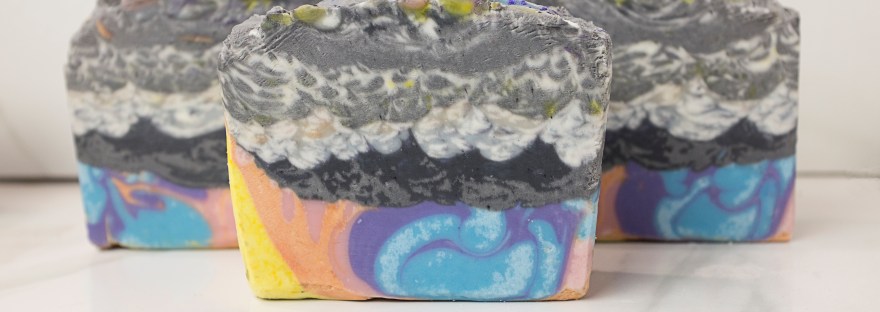
I was having a hard time choosing the colors for this soap, and at last the inspiration came from the cover of the book I had started reading / listening to:
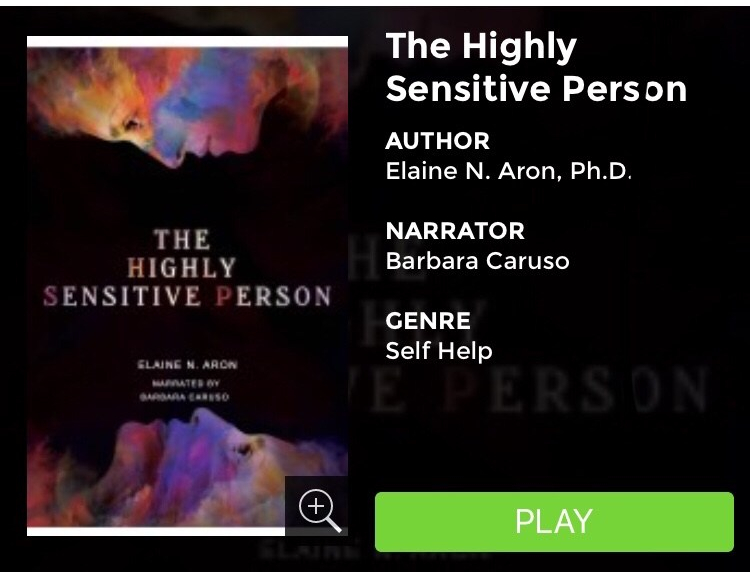
I will write more about this fascinating book below, but for now I will focus in the soap:
I liked that the color scheme looked like a sunset, so much that I did not even notice they were faces at first! The contrast against the black was stark, and I liked that. However, I am not a fan of cleaning soap scum left by black soap, so that put me in a dilemma. My first failed attempt for this July challenge had black, and I did not want to repeat the same exact colors.
I thought the faces profiles looked like volcanoes or hills, which I thought I could imitate with the pointy layer technique that the July soap challenge is about (though they may look more like miniature hills). Sadly, I did not get many pointy peaks there. However, the technique did work in the third layer, simulating the clouds that loom on top of the black. Which also helped me avoid having a large solid black portion.
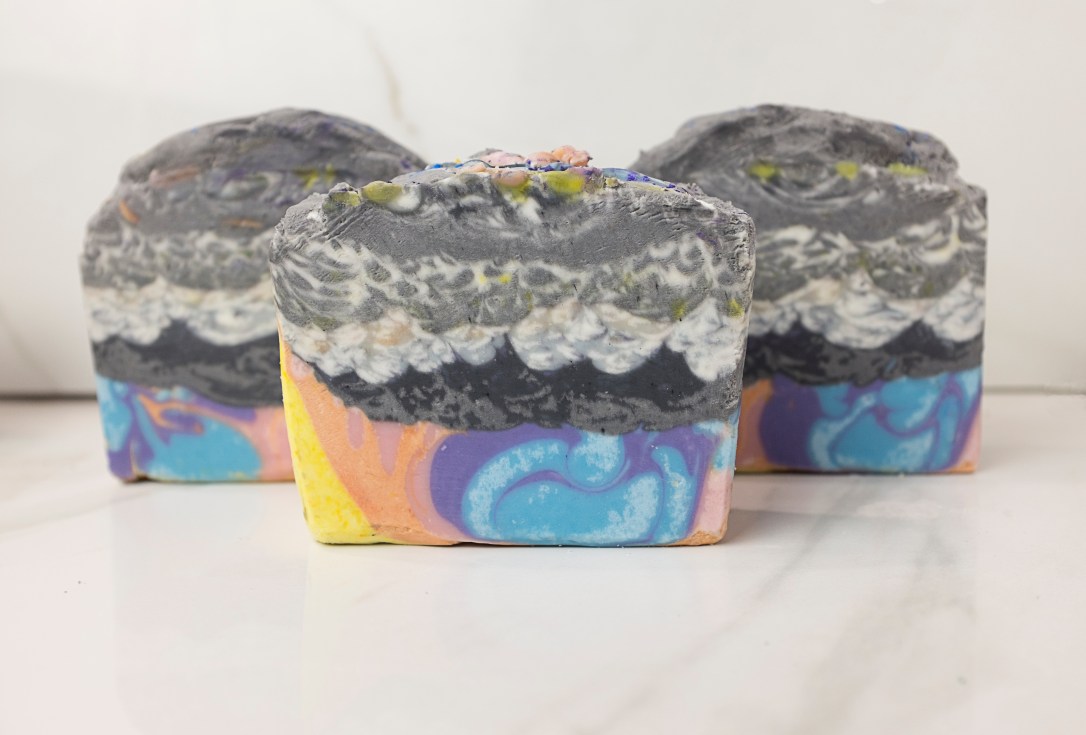
Whenever I use a recipe with so many fluid oils, I am surprised at how much soda ash forms! And then I need to wait like 3 days to unmold! I am definitely not a fan of this type of recipes! However, they do afford you such cool design ideas! what to do??
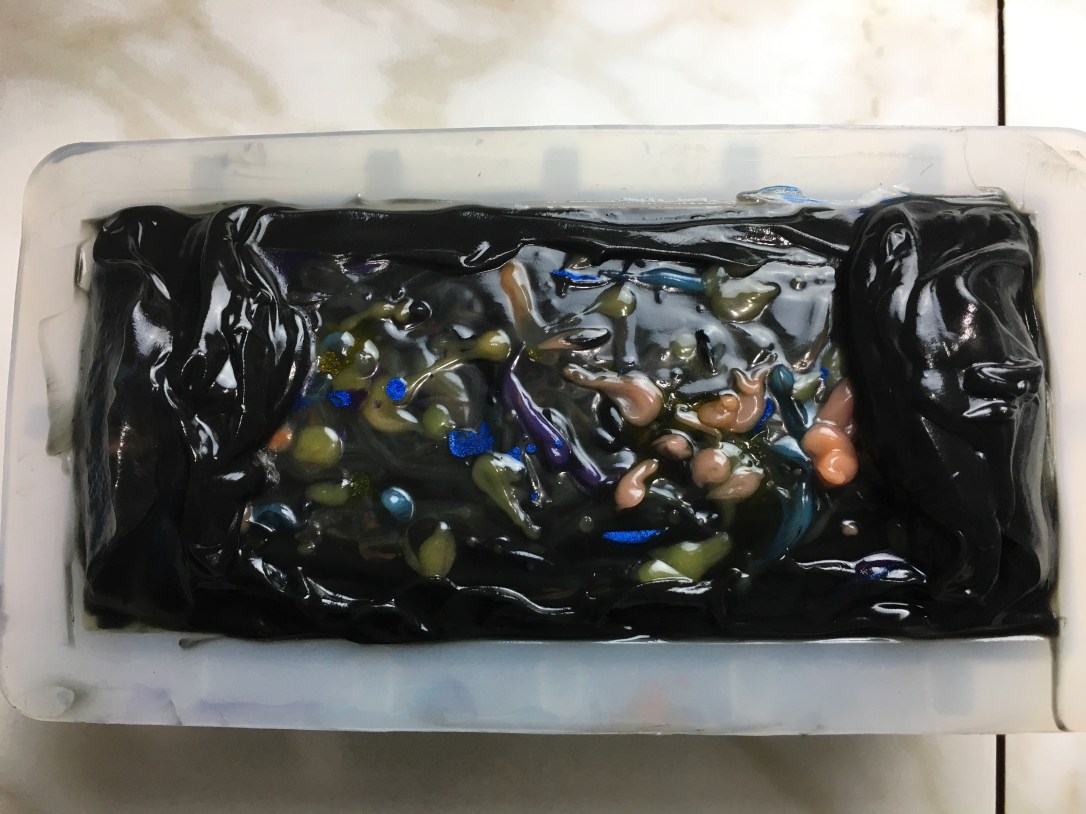
Though the top looked very dark here, it turned gray after saponification. However, this seems to be due to deep soda ash. In fact, it affected the bottom of the soap too. After some research, it seems this was due to the low temperatures when making the soap (My oils were in the 90’s F, and lye water was 89 F or so). Though I tried to make it go through gel by covering it with a cardboard box, and tucking it with a towel, which usually works; it refused to go through gel phase. Perhaps I should have oven processed it, or at least used a heat pad.
The bars were soft and crumbly, one broke while attempting to plane it (like it broke in half). I visited the soap making forum and also read this post from soap queen on soda ash. Both that post and the advice from Dee Anna at soapmakingforum suggested that the cause was the low temperature of the oils and lye. I was advised by Dee Anna, to oven process it following this video from Soapish. I did and it worked! The bars became solid and sturdy, and though the edges still appear crumbly, I was able to plane the crumbly outer part, so I was very thankful about it. They now look smooth and shiny and are no longer fragile.
I think I know why the Soapish video advises you to focus your attention on the soap and nothing else. At some point (after over 30 minutes though) some of the bars started looking like marshmallows exposed to heat, I was not sure how long to leave them in the oven for, but I kept watching them and would occasionally flip them. when I saw they were beginning to kind of melt, I took them out, waited for the oven to cool down a bit and then left them inside overnight. They did not become distorted, but do feel so much better!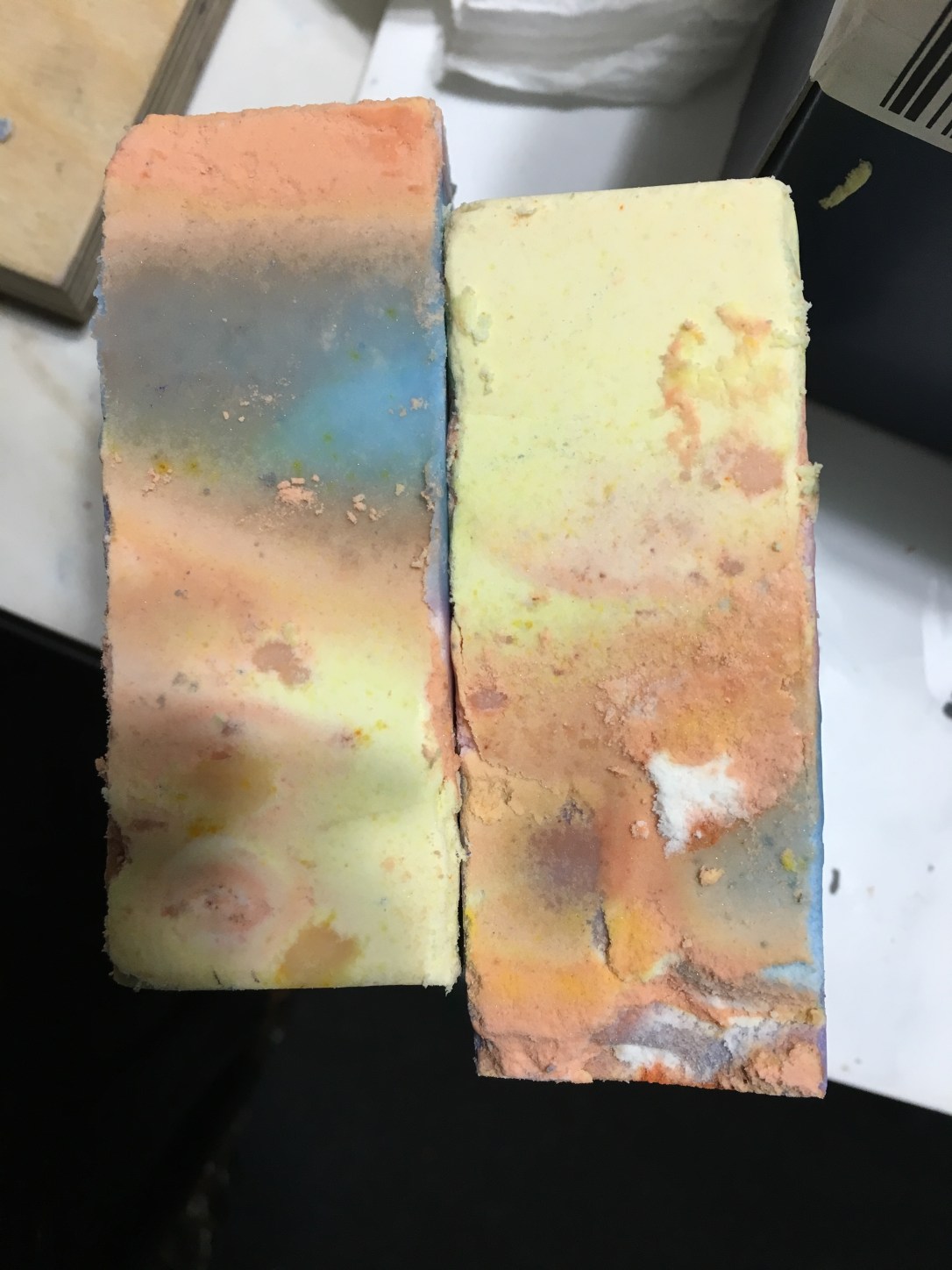
Stormy Cloud Soap Ingredients Used
Soap Ingredients
| Ingredient | Gram(s) | Ounce(s) | Pounds(s) | Oil % |
|---|---|---|---|---|
| Coconut Oil – All Grades except Virgin | 221.91 | 7.83 | 0.49 | 25% |
| Avocado Oil | 88.76 | 3.13 | 0.20 | 10% |
| Olive Oil – All Grades | 310.67 | 10.96 | 0.68 | 35% |
| Tallow, Beef | 266.29 | 9.39 | 0.59 | 30% |
| Ingredient | Gram(s) | Ounce(s) | Pounds(s) | Batch % |
| Lye – NaOH 100% Purity (5% Superfat) | 123.75 | 4.37 | 0.27 | 9.61% |
| Water (32% Lye + 68% Water Solution) | 262.96 | 9.28 | 0.58 | 20.41% |
| Total Oils | 887.62 | 31.31 | 1.96 | 68.91% |
| Soap Weight (Pre-Cook) | 1,288.17 | 45.44 | 2.84 | 100% |
- 1/16 teaspoon of Orange Vibrance Mica from Nurture Soap
- 1/8 teaspoon of Yellow #5 Lake from TKB trading
- 1/4 teaspoon of Purple Galaxy Mica from Wholesale Supplies plus
- 1/8 teaspoon of Electric Blue mica from Nurture Soap
- 1/8 teaspoon of pink mica from Bramble Berry
- 1/2 teaspoon of black oxide
Tools Needed:
Mold:
- 8″ Silicone loaf mold. It makes about 3 lb of soap (45 oz) which require about 2 lb of oils. I use this mold when I want to make a small loaf batch.
This is how I did it:
(Next time I would have the oils at 100°F / 37.778°C)
About the Book
I first watched a video about Highly Sensitive People here. It struck a cord with me, I am the one who cannot watch scary movies because I will remember them to extreme detail later when it is least convenient! And violent movies make me cringe (one of the reasons why Game of Thrones never interested me).
Although when you read the phrase Highly Sensitive Person, negative images of someone crying over nothing may come to mind, the book is not about that. It talks about many more aspects of this trait, you can also picture someone who is empathetic, who is conscientious, and very creative. So far I have learned the below (mind you I am only on chapter 2 at the moment, so there is a lot more to come):
1. Being highly sensitive is not a character flaw, and it is not a personality type
2. Being highly sensitive is a genetic trait distributed to only about 20% of the population. And people cannot change it anymore they can change their eye color. However, there are coping mechanisms.
3. This trait is also observed in higher intelligence animals, in about the same proportion (15-20% of their population).
4. There are a lot of pros that come with the trait, such as high levels of creativity, and a sort of sixth sense. (Which is your brain processing more information you may be aware of; which leads you to a decision you may not be able to explain verbally)
5. It is not the same as being introverted, some people are extroverted and have high sensitivity.
In short, this book has helped me understand a lot about myself. If you think you know someone who might be a Highly Sensitive Person, or perhaps it might be you, there is a questionnaire here for you to try.

 Soaps by Glenda