
***For the recipe, scroll down for it or click here for the video***
I felt like painting with soap recently, and once again, I turned to Vincent Vang Gogh for inspiration. I had previously done soap versions of his Almond Blossoms and his famous Starry Night.
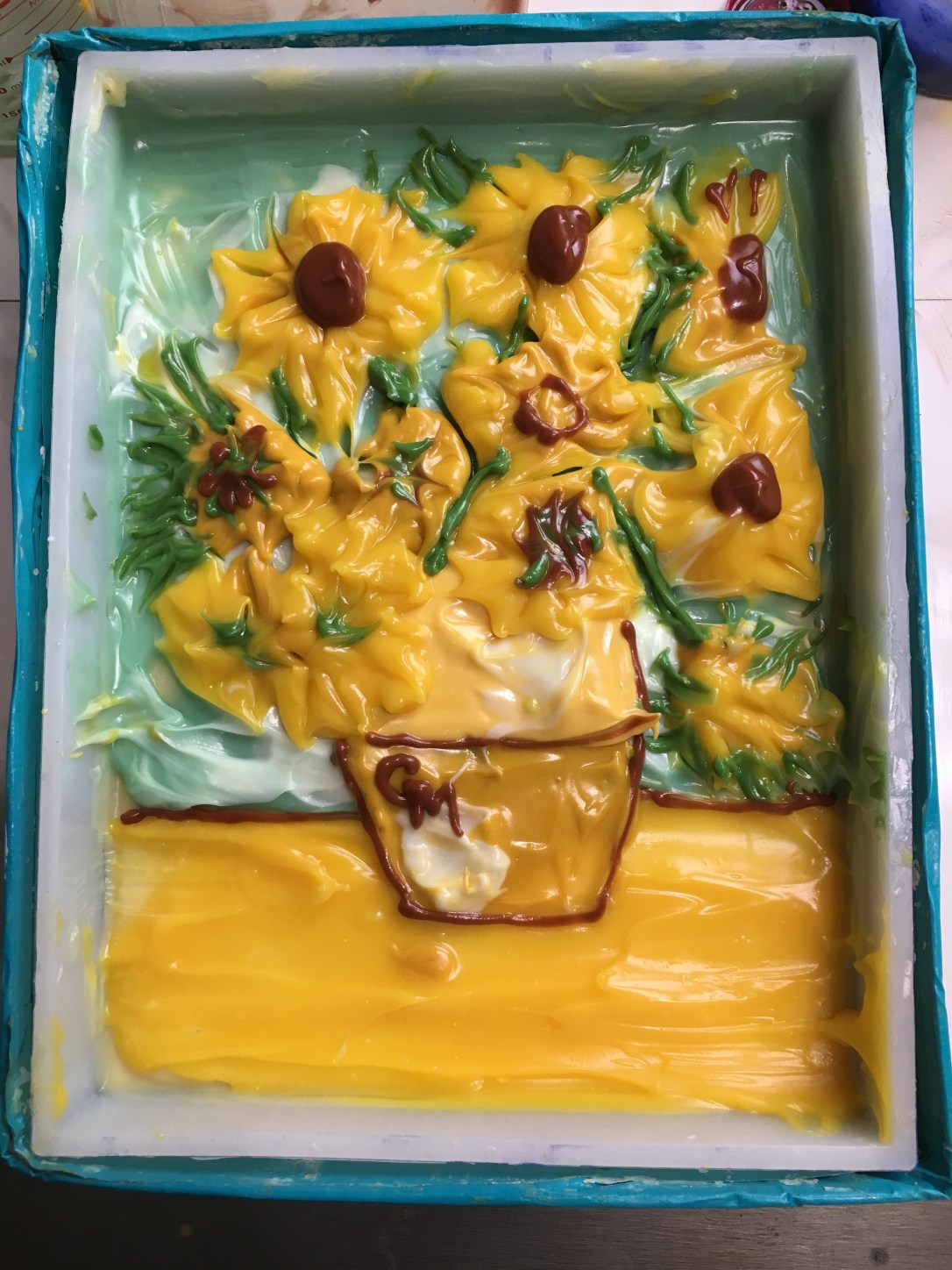
So this time, I went with his sunflower paintings. He actually painted several, and he painted them in different stages, some of his paintings are of dying sunflowers, and in some they have not bloomed yet. This wikipedia article has pictures of them. Vincent himself wrote this in a letter to his brother:
“It’s a type of painting that changes its aspect a little, which grows in richness the more you look at it. Besides, you know that Gauguin likes them extraordinarily. He said to me about them, among other things: ‘that — … that’s… the flower’. You know that Jeannin has the peony, Quost has the hollyhock, but I have the sunflower, in a way.”
Furthermore, I have been on a quest lately, to use up the discoloring fragrance oils that I have bought, especially those I bought more than a year ago. This lead me to use the fragrance only on the bottom, thicker layer of the soap; “the canvas” if you will. And leave the top unscented. This helped a lot with the “painting” process as well. No acceleration concerns there, except for the portion with titanium dioxide.

While researching the paintings, I have found some articles that talked about the colors of the original painting fading, due to the paint used at the time. What I found interesting is that Van Gogh knew the colors would fade, but he could not resist their vibrancy at the time. You can read more about that here.
Another article, mentions that some of the colors are turning brown. I wonder if they had vanillin? Just kidding!
To Cut or Not to Cut
I enjoyed making this soap, and I love how the fragrance blend turned out to be. Sometimes people in facebook ask some soap makers not to cut a soap that is made in a painting style. I usually wonder why they would suggest such a thing, as a soap this size would definitely not fit in my soap dish if I left it whole! And imagine taking a shower with it!
I do not think that is what they have in mind though, it seems they want the soap to be left untouched, or to sell it as a whole and let the buyer cut it.
This presents a couple of problems: One, for the potential buyer: cutting it later after it has cured would be very difficult and it would crumble on the edges. Secondly, where would one find such a buyer? Personally I do not sell at craft shows or markets, so it would be difficult for me personally.
Another thing to consider, if I was to keep it whole, it would be as a display piece. A soap of this size and weight could not hang on a wall easily. Arrangements would need to be done and a custom frame created. Or it would need to be displayed on a table or another piece of furniture. That would be difficult as I strive to live clutter free as much as I can (in the living areas, the craft room seems to be an entity in its own!) If I held on to every craft or painting that I make, to display it or store it, my space would be very cluttered! One of the reasons why I like soap making so much, is that it allows me to express my creativity, without worrying about creating more “stuff” that takes up room, because soap can be used up.
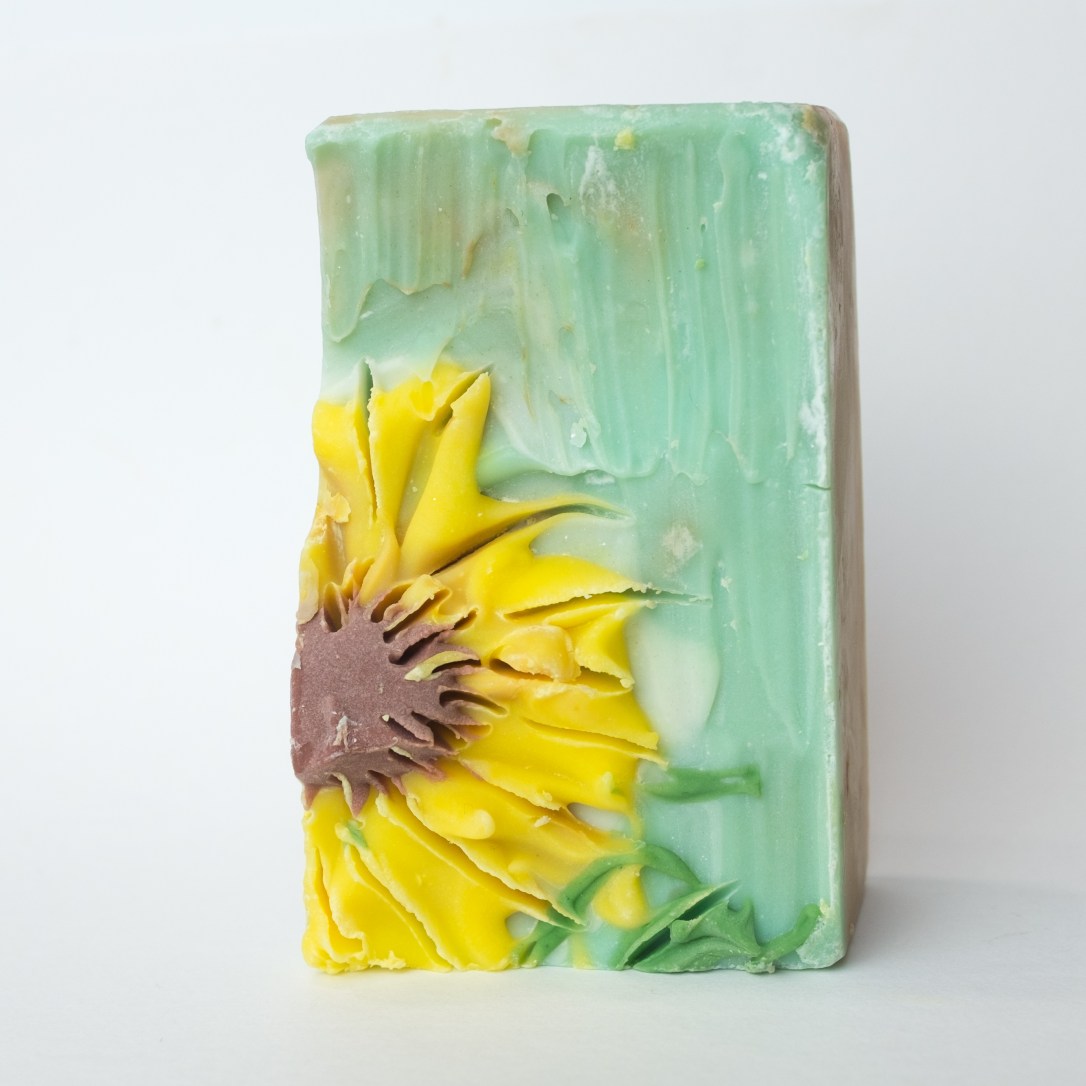
Do you have any ideas /suggestions for a future soap painting? Leave a comment below if you do.
Below is what I used, in case you are inclined to painting and want to give it a try.
Van Gogh Sunflowers Soap
Soap making experience needed:
Intermediate or Advanced
Tools Needed:
- Standard soap making tools and protective equipment
- Silicone brush (optional)
- Bamboo skewer
- Palette knives
- Small plastic bags to pipe thin lines / leaves
Mold:
Slab 11 lb mold/liner (to be filled halfway)
| Ingredient | Gram(s) | Ounce(s) | Pounds(s) | Oil % |
|---|---|---|---|---|
| Coconut Oil, 76 deg | 623.41 | 21.99 | 1.37 | 25% |
| Rice Bran Oil | 797.96 | 28.15 | 1.76 | 32% |
| Ricinus Oil (Castor Oil) | 174.55 | 6.16 | 0.38 | 7% |
| Tallow, Beef | 623.41 | 21.99 | 1.37 | 25% |
| Karite Butter (Shea) | 274.30 | 9.68 | 0.60 | 11% |
| Ingredient | Gram(s) | Ounce(s) | Pounds(s) | Batch % |
| Lye – NaOH 100% Purity (5% Superfat) | 343.73 | 12.12 | 0.76 | 9.62% |
| Water (33% Lye + 67% Water Solution) | 697.88 | 24.62 | 1.54 | 19.54% |
| Total Oils | 2,493.62 | 87.96 | 5.50 | 69.81% |
| Soap Weight (Pre-Cook) | 3,571.97 | 126 | 7.87 | 100% |
Fragrance Blend:
I have made several fragrance blends, I have not been entirely happy with most of them, but I actually like this one a lot:
- 2 oz Sandalwood Vanilla fragrance oil by Bramble Berry
- 0.80 Rose Fragrance oil by Bulk Apothecary
- 0.40 oz Satsuma orange from Nurture Soaps
- 0.50 oz Honey Fragrance formulator by Crafter´s choice
Colorants:
1/2 teaspoon Sea green mica from Nurture Soap
1/4 teaspoon of Yellow #5 Lake from TKB trading
1/4 teaspoon of Banana Boat yellow mica from Wholesale supplies plus
1/4 teaspoon of Matte Brown Oxide
1/4 Teaspoon of yellow oxide from Bulk Apothecary
1/4 Green oxide pigment from Wholesale Supplies
1/4 Teaspoon of Titanium Dioxide from Brambleberry
PROCESS:
Though I cannot give you a step by step instruction on how to paint here, here are some ideas on how you can achieve a similar soap.
For the flowers
You can make them ahead of time with soap dough, or with Melt and Pour soap, either using a mold or hand shaping them. This blog post explains more about it.
Keep them wrapped so they stay soft.
Or if you like and are able to pipe flowers, that would work too!
MAKING THE SOAP
- In a well ventilated area (outside or by a window), add the lye gradually to the distilled water. Do not breathe the fumes. You can freeze your water ahead to avoid fumes, and weigh the ice cubes. You need to wear your safety gear. Lye burns! You can prepare this several hours ahead, keep it properly covered.
- While you wait for the lye water to cool down, you can weigh and melt your oils, and weigh your fragrance oil into a glass container (fragrance oils can dissolve thin plastics)
- Mix the micas and pigments with a light colored oil like almond oil or oils from your recipe, using the mini mixer.
- Mix the Titanium dioxide with 1 tablespoon of water.
- When your oils and lye solution are below 100°F (37.77°C) or cooler, add your lye solution to the oils slowly, to avoid splatters pour it on the blender shaft.
- Stir with the blender on Off position initially, then blend for 15 second periods, alternating with stirring, until it is almost emulsified. This takes about 50 seconds to 1 minute with this recipe at the most.
- Split the soap batter so that you have 3 lbs for the painting portion and 5 lbs for the background. The soap bars turned out to be quite thick, you may use less if you prefer. I have learned I prefer to have more soap than I need when I am going to do a “painting”, and if needed, I pour leftovers in individual molds.
- If your fragrance accelerates, like most florals do (mine said it would), take a moment now to make sure you have everything you need, and understand what to do next, before proceeding.
- Get your mold ready.
- Add the fragrance to the larger portion, blend quickly and pour on the mold. Set aside.
- Divide the remaining batter into different containers. Most of it will be yellow, the background teal, and only a small portion is needed of green, white and brown. I left a portion uncolored, in case I run out and needed more of any color. I would say about 1 cup per color for most of them, about half a cup for the white, brown and green. (Keep the rest uncolored in case you need to mix up more colors).
- If you are doing embed flowers though, only worry about mixing the teal for the backdrop, the white accents and enough yellow for the vase and table (if making a vase)
- Blend the colorants briefly, so they stay fluid, but not extremely thin.
- The first color to add is the teal to cover the 2/3 of the mold, is the background.
- The table and vase are yellow and would be next
- You could then add your embeds if using. Or drop large yellow portion, in round or oval shapes all over. And follow with the brown core.
- Finish with the “leaves” and stems
- If you can manage a steady hand, outline the vase with the brown
- Accentuate the shapes with a bamboo stick by pulling and dragging the soap into shape. Once dry, you can use this too to “draw” outlines too.
Remember not to take it too seriously, have fun with it, it will go down the drain anyway. You can practice ahead with actual paint. Take your time, it took me a couple of hours to do this soap. The actual painting portion took about hour. And the planning took longer!
If you are unhappy with how yours turns out, call it an abstract version of it, perhaps a Picasso version of it (I have done that!) Either way I would love to see if it you try it!
You can watch the video of the making below:

 Soaps by Glenda
2 thoughts on “Sunflowers Soap”