

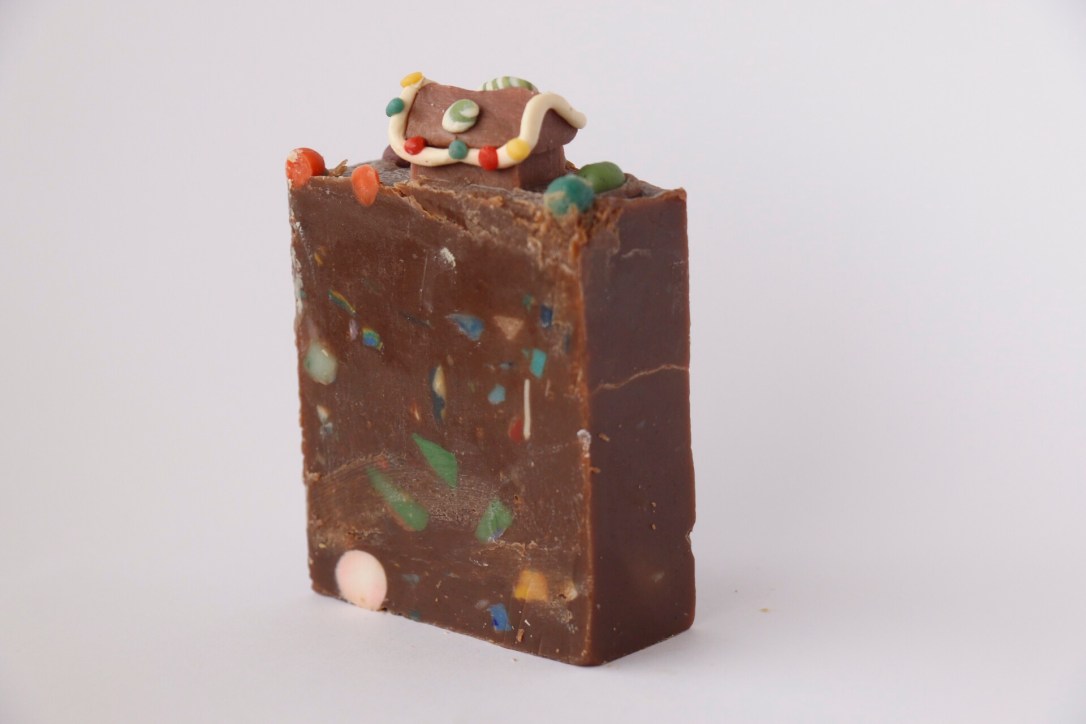
You may think that it is too late to make a Christmas soap, but perhaps it is not. When I started making soap about a year ago, I read multiple times about curing times. I read that it was not about just water evaporation, but about certain crystallization that needs to happen in the soap. This web page is often quoted in soap making groups to support that point.
In my own experience, when I followed recipes from books or blogs, I found that my soaps kept losing weight even after 6 weeks (what if humans lost weight like that? that would be something, I would be airing myself out often). Anyway, those soaps kept losing weight, though minimal amounts, even 3 months later. I should note that most of those recipes had a high content of olive oil and the recommended full water amount, the one suggested by the lye calculator (27% lye concentration or about 38% water as percentage of oils).
A few months ago, I joined yet another soap facebook group, and I saw an admin posted an announcement stating, among other things, that with the proper water discount, a soap that had cured 2 weeks could be of the same quality as a soap that had cured 4 weeks. And that Kevin Dunn (who is a respected authority in the soap making community) agreed. She also explained that the crystallization that occurred during curing was directly related to water evaporation, so it would be possible to achieve a shorter cure time if you used significantly less water in your recipe. It made me very curious, and I assumed this is something Kevin Dunn may have covered in his book Scientific Soapmaking, which I will be buying soon.
In the meantime, I decided to do a search for more information on the subject. I found this article by him and also the one listed in the group. From the diagram of the 60 days experiment comparing three different soaps, it does look like the soap that had a 50% lye concentration lost most of its moisture faster and it became harder in that time, while the other soaps took longer. In this page (page 3) there is a better view of the diagrams. If I do make more Christmas soap, I will tell my family to wait until the New Year to use it, since they are the most likely recipients of my soap. However, I will also start weighing my soaps weekly again (the ones with my recipe), to see how soon the cure is complete and compare.
Personally, I am too much of a chicken to do a 50% lye concentration, but I may attempt a 40%, currently I do a 33% lye concentration. What you need to remember with such a steep water discount, is that you will not have time to do swirls or fancy intricate designs. A soap with that little water will trace and move fast. Which is why this Hansel and Gretel’s House soap would be ideal for it, as it has soap that is already cured inside (in the form of soap shreds) so it needs a thick batter that will suspend them.
I also wanted to do the confetti style because the fragrance discolors, so the soap shreds would be the only bright color in the body of the soap.
Hansel and Gretel’s House Soap
Technically it is not their house, but hey, that is what the fragrance is called. I love this smell, is very spice/fall like. Sweet but with a cinnamon note.
Ingredient List
| Ingredient | Gram(s) | Ounce(s) | Pounds(s) | Oil % |
|---|---|---|---|---|
| Karite Butter (Shea) | 98.71 | 3.48 | 0.22 | 10% |
| Tallow, Beef | 345.50 | 12.19 | 0.76 | 35% |
| Rice Bran Oil | 246.78 | 8.71 | 0.54 | 25% |
| Ricinus Oil (Castor Oil) | 49.36 | 1.74 | 0.11 | 5% |
| Coconut Oil, 76 deg | 246.78 | 8.71 | 0.54 | 25% |
| Ingredient | Gram(s) | Ounce(s) | Pounds(s) | Batch % |
| Lye – NaOH 100% Purity (5% Superfat) | 137.15 | 4.84 | 0.30 | 9.68% |
| Water (33% Lye + 67% Water Solution) | 278.45 | 9.82 or 5.82 if using milk as below | 0.61 | 19.65% |
| Total Oils | 987.13 | 34.82 | 2.18 | 69.64% |
| Soap Weight (Pre-Cook) | 1,417.39 | 50 | 3.12 | 100% |
Fragrance:
- 2 oz of Hansel and Gretel’s House by Lone Star Candle Supply or any other spiced/ginger/holiday fragrance. This one has 4% vanilla + 3.2% ethyl vanillin
Additives:
- 0.33 oz of pumpkin puree (optional)
- 4 oz of frozen evaporated milk (optional)
- Ice for ice bath (just to keep containers cold if using milk)
Decorations:
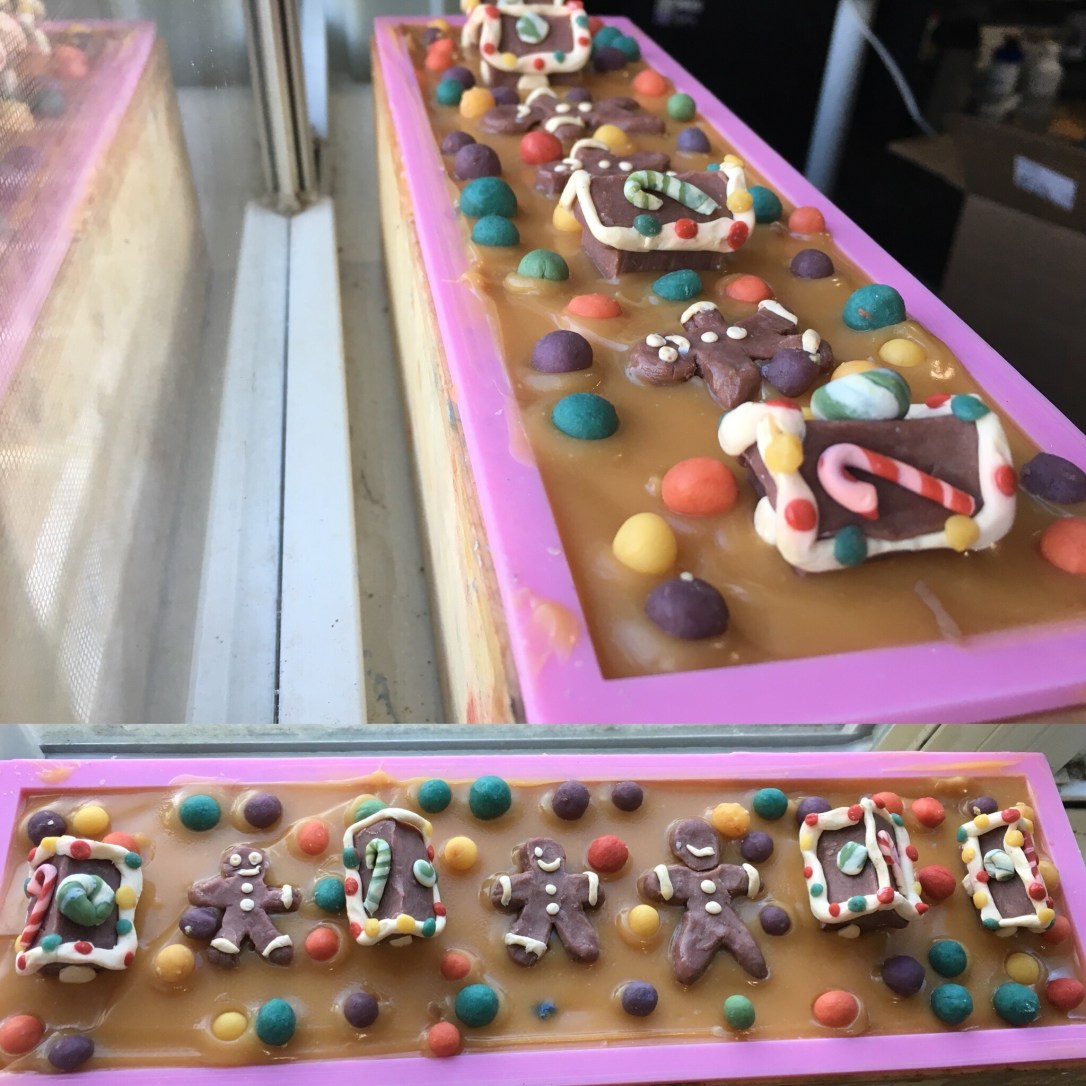
- Shredded or chopped soap in light or bright colors
- Soap dough mini balls (to simulate gum balls) in bright colors
- Brown, white, and assorted colors soap dough for the Ginger bread men and/or houses. (You could do these with Melt and Pour if you have a mold)
If you do not have soap dough, you could buy some or make from the recipe found here). Allow three days for the soap dough to be ready if making it yourself.
Equipment:
Plastic containers or buckets (Plastic #5 or #6) large enough for the lye, water, oils
- Stainless steel spoon (small to stir the lye and large to get the solid oils)
- Silicone spatula
- Hand blender
- Thermometer
- Scale
- Silicone liner for mold (or line with freezer paper)
- 3 lb loaf mold (or adjust recipe to your mold by plugging into a lye calculator)
- Individual cavity molds (to pour leftover soap in case you have any) I like having leftovers
- Safety Gear (nitrile gloves, face mask or properly sealed goggles, closed shoes). Long sleeves and pants recommended too.
- Knife or Soap cutter
- For embeds, shape cutters like this one from Michael’s that has a tiny gingerbread man
- Tile or working surface for soap dough
PROCESS:
IF USING EMBEDS, AHEAD OF TIME:
For the gum balls
Just take a small piece of soap dough and roll it between your palms in a circular motion, to create the ball shape, they do not have to be perfect!
For the houses:
Here is a general video of the making of houses, but you would need to add the little details)
Gingerbread men embeds:
If you have a miniature cutter like this one, you could roll brown soap dough (use cornstarch to prevent stickiness) and cut the gingerbread man shapes. You could then paint the details or just use the tip of a pen to draw the eyes, mouth etc. I used white soap dough to do this, but a lot of the details fell, I think I did not use a little bit of water to adhere them, like I should have.
MAKING THE SOAP
- In a well ventilated area (outside or by a window), add gradually the lye to frozen milk (if using) and then add the remaining water. If not using milk: just add lye to the distilled water and stir periodically until dissolved. Do not breathe the fumes. You can freeze your water ahead to avoid fumes. You need to wear your safety gear. Lye burns! You can prepare this several hours ahead, keep it properly covered.
- Add the pumpkin puree to the lye water if using.
- While you wait for the lye water to cool down, you can weigh and melt your oils, and weigh your fragrance oil into a glass container (fragrance oils can dissolve thin plastics)
- If using milk, keep your lye container in an ice bath to keep the milk from scorching.
- When your lye solution is at 110°F (48.88°C) or cooler, add your lye solution to the oils slowly, to avoid splatters pour it on the blender shaft.
- Stir with the blender on Off position initially, then blend for 15 second periods, alternating with stirring, until it is almost emulsified. This takes about 50 seconds to 1 minute with this recipe.
- Add the fragrance and blend for about 15 seconds and stir with the blender off until medium trace.
- You now have two options: 1. Add the soap shreds to the batter, stir and pour on mold. Or 2. Pour and alternate layers of soap and soap shreds.
- You can add the embeds to the top, if solid enough.
- Take pictures! If you used milk, put in the fridge for 6 hours, or if you will be around, keep an eye of it and if it looks like it is overheating (feels very hot and the top is cracking), move it to the freezer for 4-6 hours.
- After 8-12 more hours start checking for hardness. Try releasing from one side of the mold, and if nothing sticks back, it is ready to be removed from the mold and cut.
You can watch the video of the making below:

 Soaps by Glenda
2 thoughts on “Soap curing time and Hansel and Gretel Soap”