

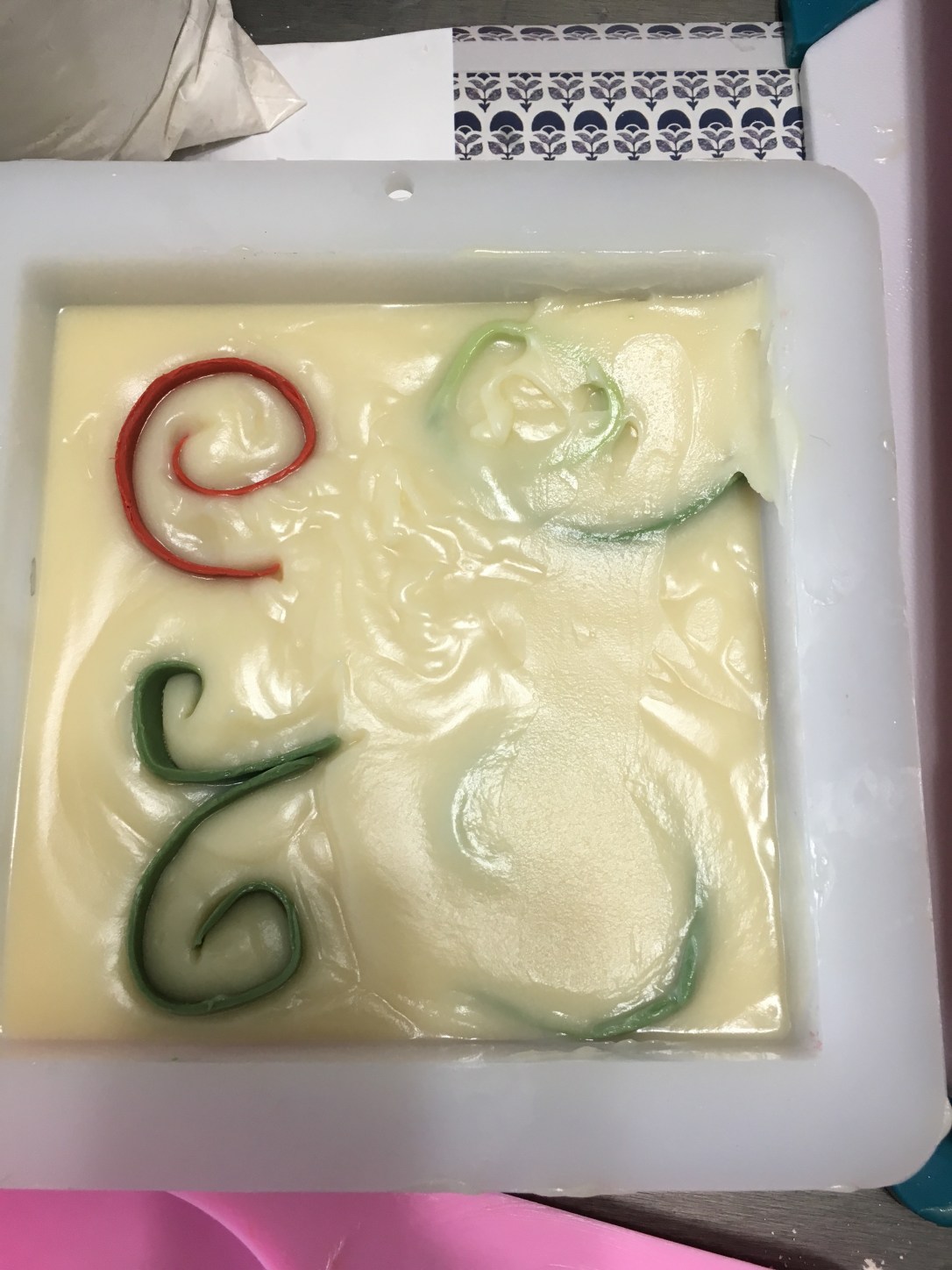
Last year I made a peppermint soap that looked like this: 
Which, in a rose mold, is not that bad. However, picture it as a bar of soap, and you may be asking next, “how much for that piece of meat? It has good marbling, can I grill it?”
However, the fragrance was soooo goood that I gave it away left and right. I used peppermint essential oil 2nd distillation. Almost a year later, I found a survivor bar and put it in the shower, I thought the smell was completely gone, but I did find a subtle scent in it after using it.
Trying to stay away from a meaty look again, I decided I would use green pigment instead of the red oxide I used before. After all, aren’t peppermint leaves green anyway?
I also decided to try a peppermint fragrance oil instead of the Essential oil. I mixed it with a little bit of musk fragrance formulator and strawberry kiwi FO for a sweet touch that would not go brown.
The creamy off white color was achieved with the light colored oils and white kaolin clay. Here is the recipe below. By the way, I also experimented using citric acid to help reduce sticky soap scum in hard water areas, hopefully it will work!
Peppermint Soap by Glenda
| Ingredient | Gram(s) | Ounce(s) | Pounds(s) | Oil % |
|---|---|---|---|---|
| Tallow, Beef | 655.72 | 23.13 | 1.45 | 37% |
| Karite Butter (Shea) | 141.75 | 5 | 0.31 | 8% |
| Coconut Oil, 76 deg | 460.96 | 16.26 | 1.02 | 26% |
| Castor Seed Oil | 88.73 | 3.13 | 0.20 | 5% |
| Cocoa Butter | 141.75 | 5 | 0.31 | 8% |
| Rice Bran Oil | 227.08 | 8.01 | 0.50 | 7% |
| Olive Oil – All Grades | 123.89 | 4.37 | 0.27 | 7% |
| Canola Oil | 35.44 | 1.25 | 0.08 | 2% |
| Ingredient | Gram(s) | Ounce(s) | Pounds(s) | Batch % |
| Lye – NaOH 100.000% Purity (0.000% Superfat) | 275.15 | 9.71 | 0.61 | 10.06% |
| Water (32.000% Lye + 68% Water Solution) | 584.70 | 20.62 | 1.29 | 21.38% |
| Total Oils | 1,875.32 | 66.15 | 4.13 | 68.56% |
| Soap Weight (Pre-Cook) | 2,735.18 | 96.48 | 6.03 | 100% |
OPTIONAL:
| Citric Acid Powder |
|
|||||||
| Extra Lye to Neutralize Citric Acid Powder | Anhydrous
Monohydrate |
|
Fragrance:
2 oz of peppermint fragrance oil (I used Lone Star Candle Supply)
0.25 oz strawberry kiwi fragrance oil (I used Lone Star Candle Supply), feel free to replace with more peppermint
0.75 oz Musk Fragrance formulator (I used Crafter’s choice)
Additives:
3 teaspoons of white kaolin clay, though a green french green clay may look nice too
1.32 oz of sodium lactate (optional)
Decoration:
If you have soap dough (you could buy or make from the recipe found here). I used green and red colors.
Equipment:
Plastic containers or buckets (Plastic #5 or #6) large enough for the lye, water, oils
- Stainless steel spoon (small to stir the lye and large to get the solid oils)
- Silicone spatula
- Hand blender
- Thermometer
- Scale
- Silicone liner for mold (or line with freezer paper)
- 5 lb slab mold, though a loaf mold could also work (or adjust recipe to your mold by plugging into a lye calculator)
- Individual cavity molds (to pour leftover soap in case you have any) I like having leftovers
- Safety Gear (nitrile gloves, face mask or properly sealed goggles, closed shoes). Long sleeves and pants recommended too.
- Deli plastic sheets
- Tile or surface to work with soap dough
- Knife
- Slab mold (I used a small slab mold and individual cavities molds
PROCESS:
IF USING EMBEDS, AHEAD OF TIME:
- Roll a small log of soap dough in between deli sheets to create a thin layer. You could use a wine bottle or other cylinder shape container to flatten. If you do not have delit sheets, saran wrap should work, or you can use cornstarch instead to keep the soap dough from sticking.
- Cut a rectangle that is as wide as your mold is tall.
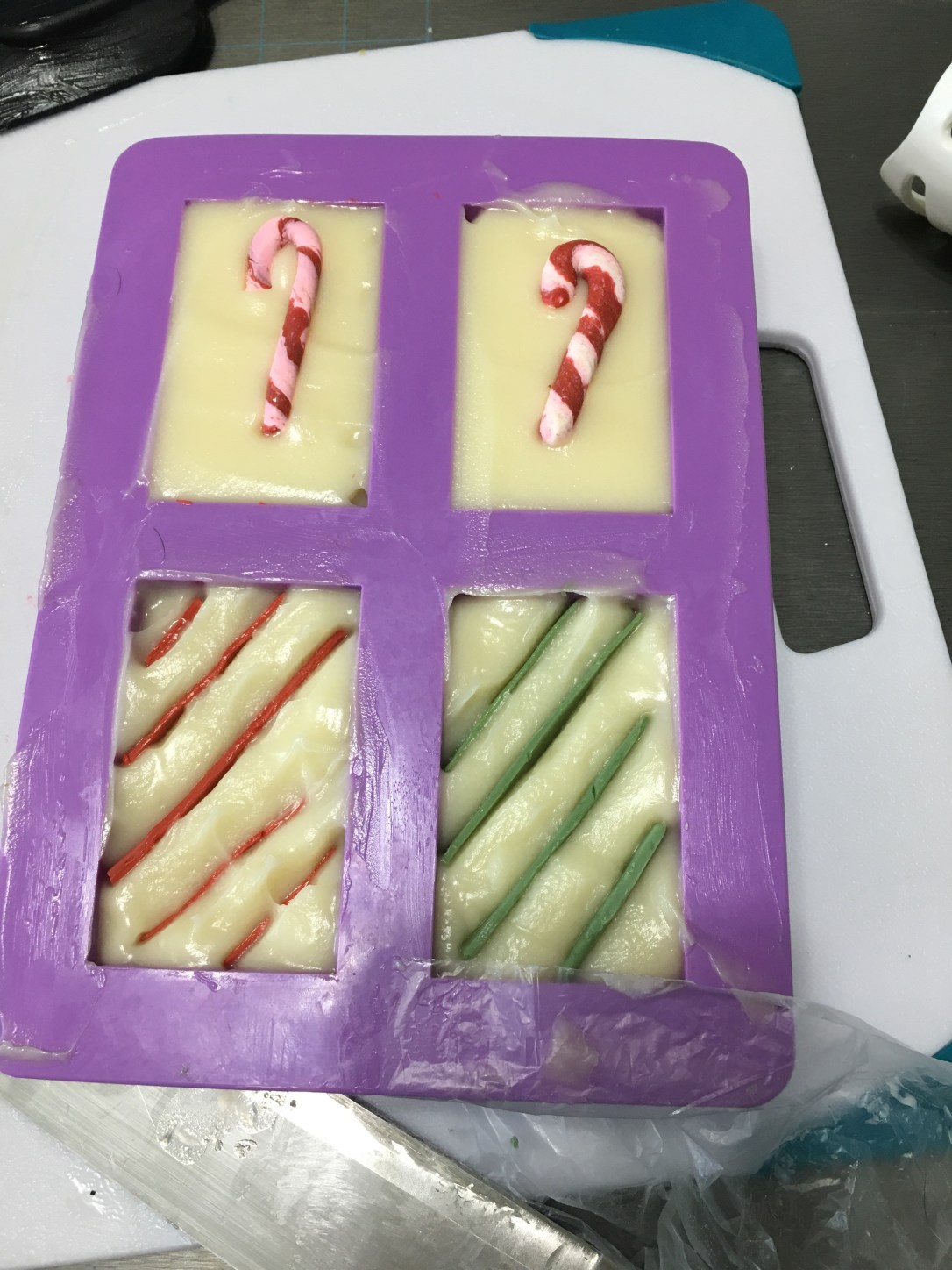
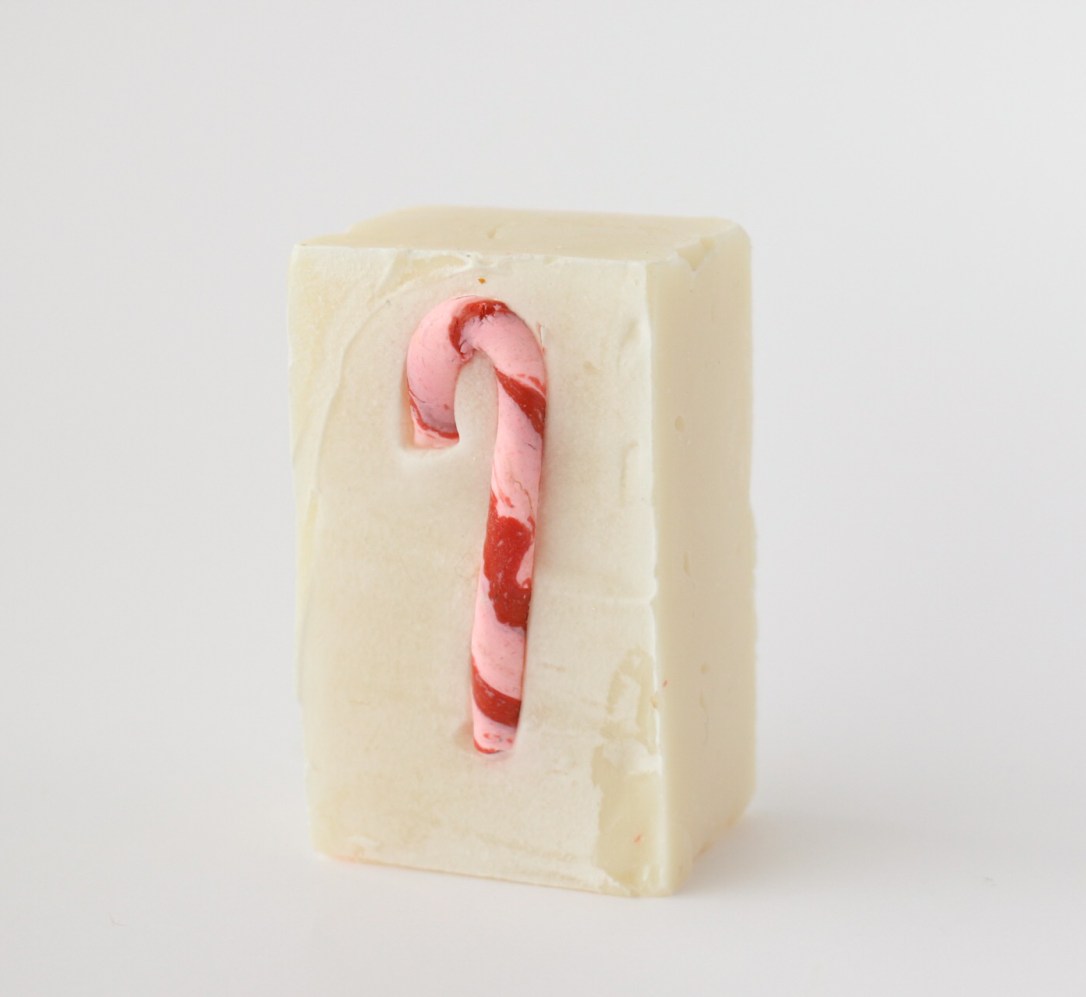
- For a candy cane look, Cut the rectangles to the appropriate size of your mold to be inserted diagonally. you could curve them instead to make random swirl patterns. Have fun with it. Keep the soap dough rectangles wrapped so it remains moist, unless you are making it right before making the soap.
MAKING THE SOAP
- In a well ventilated area, add gradually the lye to the distilled water and stir periodically until dissolved. Do not breathe the fumes. You can freeze your water ahead to avoid fumes. You need to wear your safety gear. lye burns! You can prepare this several hours ahead, keep it properly covered. If you are using citric acid and do not want your superfat to increase, add the corresponding amount of extra lye as outlined above.
- Add the sodium lactate to lye water after, if using. You can now wait until it comes to room temperature, or to 120 °F (48.88 °C) at least.
- While you wait for lye to cool down, you can mix or measure the kaolin clay, and disperse it in about 3 tablespoons of water. You can set this aside, or you can add it directly to your lye water.
- If using, weigh the citric acid and mix it with twice its weight in water. For example, if you are using 1.32 oz of citric acid, dissolve it in 2.60 oz of water. Set apart.
- Weigh your oils and heat them up until they are clear (I put mine in the microwave for a couple minutes).
- Add your lye solution to the oils slowly, to avoid splatters pour it on the blender shaft.
- Stir with the blender on Off position initially, then blend for 15 second periods, alternating with stirring, until you can no longer see the oils but it all looks blended (emulsified). This takes about 50 seconds to 1 minute with this recipe.
- If you did not add the kaolin clay to the lye water, add it now to the soap batter, also add the citric acid mix (if using),
- Add the fragrance
- And now blend until all is incorporated (about 15 seconds)
- Pour it all out on your molds
- Add the soap dough embeds if using, in a diagonal pattern.
You can watch the process here:

 Soaps by Glenda